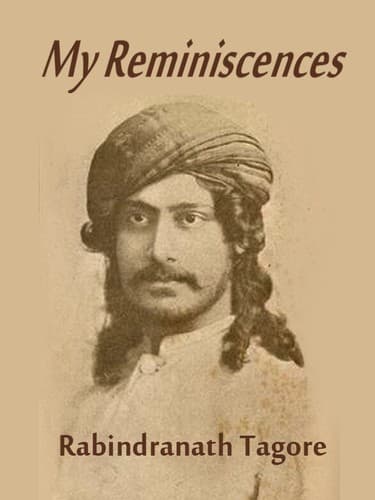
Authors, Bengali -- 20th century -- Biography; Tagore, Rabindranath, 1861-1941
After this, as I went on hearing and learning more and more of European
music, I began to get into the spirit of it; but up to now I am
convinced that our music and theirs abide in altogether different
apartments, and do not gain entry to the heart by the self-same door.
European music seems to be intertwined with its material life, so that
the text of its songs may be as various as that life itself. If we
attempt to put our tunes to the same variety of use they tend to lose
their significance, and become ludicrous; for our melodies transcend the
barriers of everyday life, and only thus can they carry us so deep into
Pity, so high into Aloofness; their function being to reveal a picture
of the inmost inexpressible depths of our being, mysterious and
impenetrable, where the devotee may find his hermitage ready, or even
the epicurean his bower, but where there is no room for the busy man of
the world.
I cannot claim that I gained admittance to the soul of European music.
But what little of it I came to understand from the outside attracted me
greatly in one way. It seemed to me so romantic. It is somewhat
difficult to analyse what I mean by that word. What I would refer to is
the aspect of variety, of abundance, of the waves on the sea of life, of
the ever-changing light and shade on their ceaseless undulations. There
is the opposite aspect--of pure extension, of the unwinking blue of the
sky, of the silent hint of immeasureability in the distant circle of the
horizon. However that may be, let me repeat, at the risk of not being
perfectly clear, that whenever I have been moved by European music I
have said to myself: it is romantic, it is translating into melody the
evanescence of life.
Not that we wholly lack the same attempt in some forms of our music; but
it is less pronounced, less successful. Our melodies give voice to the
star-spangled night, to the first reddening of dawn. They speak of the
sky-pervading sorrow which lowers in the darkness of clouds; the
speechless deep intoxication of the forest-roaming spring.
(29) _Valmiki Pratibha_
We had a profusely decorated volume of Moore's Irish Melodies: and often
have I listened to the enraptured recitation of these by Akshay Babu.
The poems combined with the pictorial designs to conjure up for me a
dream picture of the Ireland of old. I had not then actually heard the
original tunes, but had sung these Irish Melodies to myself to the
accompaniment of the harps in the pictures. I longed to hear the real
tunes, to learn them, and sing them to Akshay Babu. Some longings
unfortunately do get fulfilled in this life, and die in the process.
When I went to England I did hear some of the Irish Melodies sung, and
learnt them too, but that put an end to my keenness to learn more. They
were simple, mournful and sweet, but they somehow did not fit in with
the silent melody of the harp which filled the halls of the Old Ireland
of my dreams.
Public-domain text, read in full here on John Shaqi.
Reviews
Reviews
No reviews yet
Be the first to share your thoughts on this work.
Elsewhere in the archive
Join the Discussion
Join the discussion
Sign in to leave a comment or review.
Sign InorCreate an account