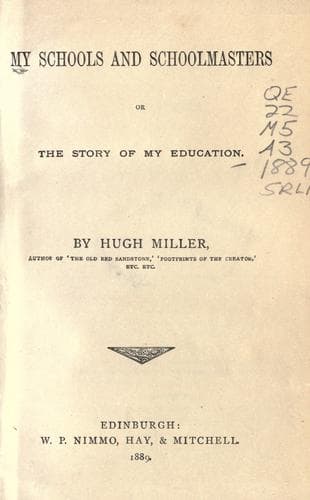
My Schools and Schoolmasters; Or, The Story of My EducationMiller, Hugh
Philosophy
My Schools and Schoolmasters; Or, The Story of My Education
Miller, Hugh
Education -- Scotland -- History -- 19th century; Geologists -- Scotland -- Biography; Miller, Hugh, 1802-1856 -- Knowledge and learning
My amusements had undergone very little change: I was even fonder of the
shores and woods than ever, and better acquainted with the rocks and
caves. A very considerable change, however, had taken place in the
amusements of the school-fellows my contemporaries, who were now from
two to three years older than when I had been associated with them in
the parish school. Hy-spy had lost its charms; nor was there much of its
old interest for them in French and English; whereas my rock excursions
they came to regard as very interesting indeed. With the exception of my
friend of the cave, they cared little about rocks or stones; but they
all liked brambles, and sloes, and _craws-apples_, tolerably well, and
took great delight in assisting me to kindle fires in the caverns of the
old-coast line, at which we used to broil shell-fish and crabs, taken
among the crags and boulders of the ebb below, and roast potatoes,
transferred from the fields of the hill above. There was one cave, an
especial favourite with us, in which our fires used to blaze day after
day for weeks together. It is deeply hollowed in the base of a steep
ivy-mantled precipice of granitic gneiss, a full hundred feet in height;
and bears on its smoothed sides and roof, and along its uneven
bottom,--fretted into pot-like cavities, with large rounded pebbles in
them,--unequivocal evidence that the excavating agent to which it owed
its existence had been the wild surf of this exposed shore. But for more
than two thousand years wave had never reached it: the last general
elevation of the land had raised it beyond the reach of the highest
stream-tides; and when my gang and I took possession of its twilight
recesses, its stony sides were crusted with mosses and liverworts; and
a crop of pale, attenuated, sickly-looking weeds, on which the sun had
never looked in his strength, sprang thickly up over its floor. In the
remote past it had been used as a sort of garner and thrashing-place by
a farmer of the parish, named Marcus, who had succeeded in rearing crops
of bere and oats on two sloping plots at the foot of the cliffs in its
immediate neighbourhood; and it was known, from this circumstance, to my
uncles and the older inhabitants of the town, as Marcus's Cave. My
companions, however, had been chiefly drawn to it by a much more recent
association. A poor Highland pensioner--a sorely dilapidated relic of
the French-American War, who had fought under General Wolfe in his
day--had taken a great fancy to the cave, and would fain have made it
his home. He was ill at ease in his family;--his wife was a termagant,
and his daughter disreputable; and, desirous to quit their society
altogether, and live as a hermit among the rocks, he had made
application to the gentleman who tenanted the farm above, to be
permitted to fit up the cave for himself as a dwelling. So bad was his
English, however, that the gentleman failed to understand him; and his
Public-domain text, read in full here on John Shaqi.
Reviews
Reviews
No reviews yet
Be the first to share your thoughts on this work.
Elsewhere in the archive
Join the Discussion
Join the discussion
Sign in to leave a comment or review.
Sign InorCreate an account