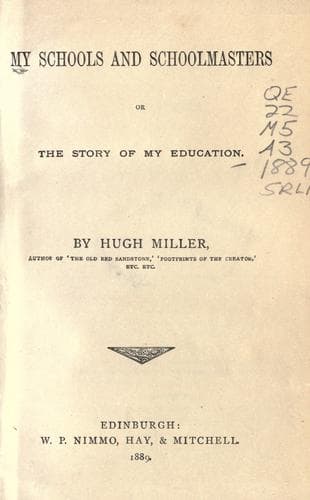
My Schools and Schoolmasters; Or, The Story of My EducationMiller, Hugh
Philosophy
My Schools and Schoolmasters; Or, The Story of My Education
Miller, Hugh
Education -- Scotland -- History -- 19th century; Geologists -- Scotland -- Biography; Miller, Hugh, 1802-1856 -- Knowledge and learning
when the affair had ended, and march straight out of school. And thus
terminated my school education. Before night I had avenged myself, in a
copy of satiric verses, entitled "The Pedagogue," which--as they had
some little cleverness in them, regarded as the work of a boy, and as
the known eccentricities of their subject gave me large
scope--occasioned a good deal of merriment in the place; and of the
verses a fair copy, written out by Finlay, was transmitted through the
Post-Office to the pedagogue himself. But the only notice he ever took
of them was incidentally, in a short speech made to the copyist a few
days after. "I _see_, Sir," he said,--"I _see_ you still associate with
that fellow Miller; perhaps he will make you a poet!" "I had thought,
Sir," said Finlay very quietly, in reply, "that poets were born--not
made."
As a specimen of the rhyme of this period, and as in some degree a
set-off against my drubbing, which remains till this day an unsettled
score, I submit my pasquinade to the reader:--
THE PEDAGOGUE.
With solemn mien and pious air,
S--k--r attends each call of grace;
Loud eloquence bedecks his prayer,
And formal sanctity his face.
All good; but turn the other side,
And see the smirking beau displayed;
The pompous strut, exalted air,
And all that marks the fop, is there.
In character we seldom see
Traits so diverse meet and agree:
Can the affected mincing trip,
Exalted brow, and pride-pressed lip,
In strange incongruous union meet,
With all that stamps the hypocrite?
We see they do: but let us scan
Those secret springs which move the man.
Though now he wields the knotty birch,
His better hope lies in the Church:
For this the sable robe he wears,
For this in pious guise appears.
But then, the weak will cannot hide
Th' inherent vanity and pride;
And thus he acts the coxcomb's part,
As dearer to his poor vain heart:
Nature's born fop! a saint by art!!
But hold! he wears no fopling's dress
Each seam, each thread, the eye can trace
His garb all o'er;--the dye, though true,
Time-blanch'd, displays a fainter hue:
Dress forms the fopling's better part;
Reconcile this, and prove your art.
"Chill penury represses pride;"--
A maxim by the wise denied;
For 'tis alone tame plodding souls,
Whose spirits bend when it controls,--
Whose lives run on in one dull same,
Plain honesty their highest aim.
With him it merely can repress--
Tailor o'er-cow'd--the pomp of dress;
His spirit, unrepressed, can soar
High as e'er folly rose before;
Can fly pale study, learn'd debate,
And ape proud fashion's idle state:
Yet fails in that engaging grace
That lights the practised courtier's face.
His weak affected air we mark,
And, smiling, view the would-be spark;
Complete in every act and feature,--
An ill-bred, silly, awkward creature.
Public-domain text, read in full here on John Shaqi.
Reviews
Reviews
No reviews yet
Be the first to share your thoughts on this work.
Elsewhere in the archive
Join the Discussion
Join the discussion
Sign in to leave a comment or review.
Sign InorCreate an account