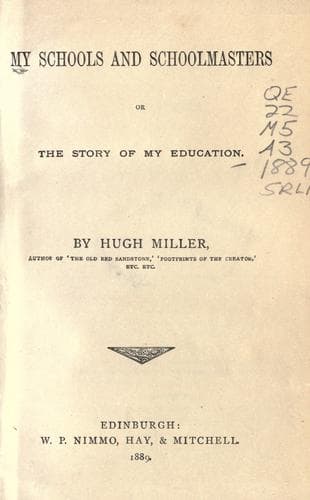
My Schools and Schoolmasters; Or, The Story of My EducationMiller, Hugh
Philosophy
My Schools and Schoolmasters; Or, The Story of My Education
Miller, Hugh
Education -- Scotland -- History -- 19th century; Geologists -- Scotland -- Biography; Miller, Hugh, 1802-1856 -- Knowledge and learning
Before daybreak the maniac succeeded in setting herself free; but the
paroxysm of the fit had meanwhile passed over; and when she visited me
next morning at the place where I was hewing--a little apart from the
other workmen, who were all engaged in building on the walls--save for
the strongly-marked features, I would scarce have recognised her. She
was neatly dressed, though her gown was neither fine nor new; her clean
white cap was nicely arranged; and her air seemed to be rather that of
the respectable tradesman's wife or daughter, than of the ordinary
country woman. For some little time she stood beside me without
speaking, and then somewhat abruptly asked,--"What makes _you_ work as a
mason?" I made some commonplace reply; but it failed to satisfy her.
"All your fellows are real masons," she said; "but you are merely in the
disguise of a mason; and I have come to consult you about the deep
matters of the soul." The matters she had come to inquire regarding were
really very deep indeed; she had, I found, carefully read Flavel's
"Treatise on the Soul of Man"--a volume which, fortunately for my
credit, I also had perused; and we were soon deep together in the rather
bad metaphysics promulgated on the subject by the Schoolmen, and
republished by the divine. It seemed clear, she said, that every human
soul was created--not transmitted--created, mayhap, at the time when it
began to be; but if so, how, or on what principle did it come under the
influence of the Fall? I merely remarked, in reply, that she was of
course acquainted with the views of the old theologians--_such as
Flavel_--men who really knew as much about such things as could be
known, and perhaps a little more: was she not satisfied with them? Not
dissatisfied, she said; but she wanted more light. Could a soul not
derived from our first parents be rendered vile simply by being put into
a body derived from them? One of the passages in Flavel, on this special
point, had luckily struck me, from its odd obscurity of expression, and
I was able to quote it in nearly the original words. You know, I
remarked, that a great authority on the question "declined confidently
to affirm that the moral infection came by way of physical agency, as a
rusty scabbard infects and defiles a bright sword when sheathed therein:
it might be," he thought, "by way of natural concomitancy, as Estius
will have it; or, to speak as Dr. Reynolds doth, by way of ineffable
resultancy and emanation." As this was perfectly unintelligible, it
seemed to satisfy my new friend. I added, however, that, like herself, I
was waiting for more light on the difficulty, and might set myself to it
in right earnest, when I found it fully demonstrated that the Creator
could not, or did not, make man equally the descendant in soul as in
body of the original progenitors of the race. I believed, with the great
Mr. Locke, that he could do it; nor was I aware he had anywhere said
that what he could do in the matter he had not done.
Public-domain text, read in full here on John Shaqi.
Reviews
Reviews
No reviews yet
Be the first to share your thoughts on this work.
Elsewhere in the archive
Join the Discussion
Join the discussion
Sign in to leave a comment or review.
Sign InorCreate an account