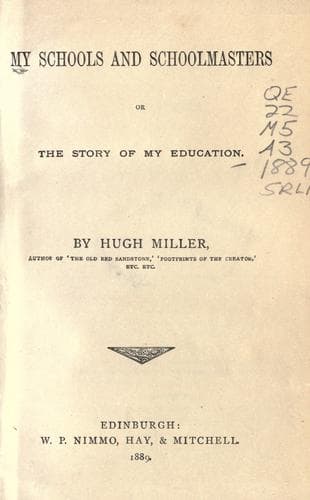
My Schools and Schoolmasters; Or, The Story of My EducationMiller, Hugh
Philosophy
My Schools and Schoolmasters; Or, The Story of My Education
Miller, Hugh
Education -- Scotland -- History -- 19th century; Geologists -- Scotland -- Biography; Miller, Hugh, 1802-1856 -- Knowledge and learning
Such was the first
of many strange conversations with the maniac, who, with all her sad
brokenness of mind, was one of the most intellectual women I ever knew.
Humble as were the circumstances in which I found her, her brother, who
was at this time about two years dead, had been one of the best-known
ministers of the Scottish Church in the Northern Highlands. To quote
from an affectionate notice by the editor of a little volume of his
sermons, published a few years ago--the Rev. Mr. Mackenzie of North
Leith--"he was a profound divine, an eloquent preacher, a
deeply-experienced Christian, and, withal, a classical scholar, a
popular poet, a man of original genius, and eminently a man of prayer."
And his poor sister Isabel, though grievously vexed at times by a dire
insanity, seemed to have received from nature powers mayhap not inferior
to his.
We were not always engaged with the old divines; Isabel's tenacious
memory was stored with the traditions of the district; and many an
anecdote could she tell of old chieftains, forgotten on the lands which
had once been their own, and of Highland poets, whose songs had been
sung for the last time. The story of the "Raid of Gillie-christ" has
been repeatedly in print since I first heard it from her: it forms the
basis of the late Sir Thomas Dick Lander's powerful tale of "Allan with
the Red Jacket;" and I have seen it in its more ordinary traditionary
dress, in the columns of the _Inverness Courier_. But at this time it
was new to me; and on no occasion could it have lost less by the
narrator. She was herself a Mackenzie; and her eyes flashed a wild fire
when she spoke of the barbarous and brutal Macdonalds, and of the
measured march and unfaltering notes of their piper outside the burning
chapel, when her perishing ancestors were shrieking in their agony
within. She was acquainted also with the resembling story of that Cave
of Eigg, in which a body of the Macdonalds themselves, consisting of
men, women, and children--the entire population of the island--had been
suffocated wholesale by the Macleods of Skye; and I have heard from her
more good sense on the subject of the Highland character "ere the gospel
changed it," as illustrated by these passages in their history, than
from some Highlanders sane enough on other matters, but carried away by
a too indiscriminating respect for the wild courage and half-instinctive
fidelity of the old race. The ancient Highlanders were bold, faithful
dogs, she has said, ready to die for their masters, and prepared to do,
at their bidding, like other dogs, the most cruel and wicked actions;
and as dogs often were they treated; nay, even still, after religion had
made them men (as if condemned to suffer for the sins of their parents),
they were frequently treated as dogs. The pious martyrs of the south had
contended in God's behalf; whereas the poor Highlanders of the north had
but contended in behalf of their chiefs; and so, while God had been kind
Public-domain text, read in full here on John Shaqi.
Reviews
Reviews
No reviews yet
Be the first to share your thoughts on this work.
Elsewhere in the archive
Join the Discussion
Join the discussion
Sign in to leave a comment or review.
Sign InorCreate an account