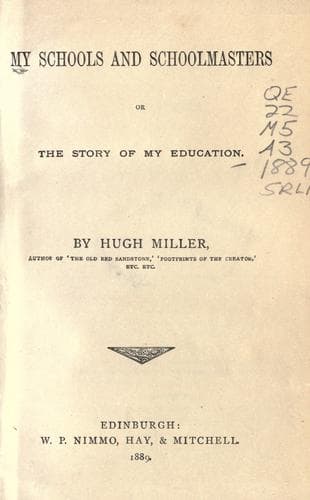
My Schools and Schoolmasters; Or, The Story of My EducationMiller, Hugh
Philosophy
My Schools and Schoolmasters; Or, The Story of My Education
Miller, Hugh
Education -- Scotland -- History -- 19th century; Geologists -- Scotland -- Biography; Miller, Hugh, 1802-1856 -- Knowledge and learning
surprise and perplex the student of human character. As a misdirected
toe-nail, injured by pressure, sometimes turns round, and, re-entering
the flesh, vexes it into a sore, it would seem as if that noble
inventive faculty to which we owe the parable and the epic poem, were
liable, when constrained by self-love, to similar misdirections; and
certainly, when turned inwards upon its possessor, the moral character
festers or grows callous around it.
There was no one in the barrack with whom I cared much to converse, or
who, in turn, cared much to converse with me; and so I learned, on the
occasions when the company got dull, and broke up into groups, to retire
to the hay-loft where I slept, and pass there whole hours seated on my
chest. The loft was a vast apartment, some fifty or sixty feet in
length, with its naked rafters raised little more than a man's height
over the floor; but in the starlit nights, when the openings in the wall
assumed the character of square patches of darkness-visible stamped upon
utter darkness, it looked quite as well as any other unlighted place
that could not be seen; and in nights brightened by the moon, the pale
beams, which found access at openings and crevices, rendered its wide
area quite picturesque enough for ghosts to walk in. But I never saw
any; and the only sounds I heard were those made by the horses in the
stable below, champing and snorting over their food. They were, I doubt
not, happy enough in their dark stalls, because they were horses, and
had plenty to eat; and I was at times quite happy enough in the dark
loft above, because I was a man, and could think and imagine. It is, I
believe, Addison who remarks, that if all the thoughts which pass
through men's minds were to be made public, the great difference which
seems to exist between the thinking of the wise and of the unwise would
be a good deal reduced; seeing that it is a difference which does not
consist in their not having the same weak thoughts in common, but
merely in the prudence through which the wise suppress their foolish
ones. I still possess notes of the cogitations of these solitary
evenings, ample enough to show that they were extraordinary combinations
of the false and the true; but I at the same time hold them sufficiently
in memory to remember, that I scarce, if at all, distinguished between
what was false and true in them at the time. The literature of almost
every people has a corresponding early stage, in which fresh thinking is
mingled with little conceits, and in which the taste is usually false,
but the feeling true.
Let me present my young readers, from my notes, with the variously
compounded cogitations of one of these quiet evenings. What formed so
long ago one of my exercises may now form one of theirs, if they but set
themselves to separate the solid from the unsolid thinking contained in
my abstract.
MUSINGS.
Public-domain text, read in full here on John Shaqi.
Reviews
Reviews
No reviews yet
Be the first to share your thoughts on this work.
Elsewhere in the archive
Join the Discussion
Join the discussion
Sign in to leave a comment or review.
Sign InorCreate an account