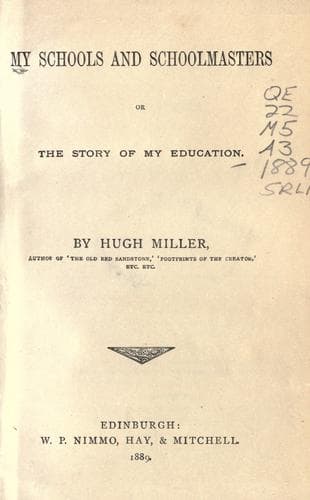
My Schools and Schoolmasters; Or, The Story of My EducationMiller, Hugh
Philosophy
My Schools and Schoolmasters; Or, The Story of My Education
Miller, Hugh
Education -- Scotland -- History -- 19th century; Geologists -- Scotland -- Biography; Miller, Hugh, 1802-1856 -- Knowledge and learning
people, to find more to pity than to envy in the condition of their
neighbours; and I remember that at this time, and for years after, I
used to deem the trait a good one. I have now, however, my doubts on the
subject, and am not quite sure whether a content so general as to be
national may not, in certain circumstances, be rather a vice than a
virtue. It is certainly no virtue when it has the effect of arresting
either individuals or peoples in their course of development; and is
perilously allied to great suffering, when the men who exemplify it are
so thoroughly happy amid the mediocrities of the present, that they fail
to make provision for the contingencies of the future.
We were joined in about a fortnight by the other workmen from the Low
country, and I resigned my temporary charge (save that I still retained
the time-book in my master's behalf) into the hands of an ancient mason,
remarkable over the north of Scotland for his skill as an operative, and
who, though he was now turned of sixty, was still able to build and hew
considerably more than the youngest and most active man in the squad. He
was at this time the only survivor of three brothers, all masons, and
all not merely first-class workmen, but of a class to which, at least to
the north of the Grampians, only they themselves belonged, and very
considerably in advance of the first. And on the removal of the second
of the three brothers to the south of Scotland, it was found that, amid
the stone-cutters of Glasgow, David Fraser held relatively the same
place that he had done among those of the north. I have been told by Mr.
Kenneth Matheson--a gentleman well known as a master-builder in the west
of Scotland--that in erecting some hanging stairs of polished stone,
ornamented in front and at the outer edge by the common fillet and
torus, his ordinary workmen used to complete for him their one step
a-piece per day, and David Fraser his _three_ steps, finished equally
well. It is easily conceivable how, in the higher walks of art, one man
should excel a thousand--nay, how he should have neither competitor when
living, nor successor when dead. The English gentleman who, after the
death of Canova, asked a surviving brother of the sculptor whether he
purposed carrying on Canova's _business_, found that he had achieved in
the query an unintentional joke. But in the commoner avocations there
appear no such differences between man and man; and it may seem strange
how, in ordinary stone-cutting, one man could thus perform the work of
three. My acquaintance with old John Fraser showed me how very much the
ability depended on a natural faculty. John's strength had never been
above the average of that of Scotchmen, and it was now considerably
reduced; nor did his mallet deal more or heavier blows than that of the
common workman. He had, however, an extraordinary power of conceiving of
the finished piece of work, as lying within the rude stone from which it
Public-domain text, read in full here on John Shaqi.
Reviews
Reviews
No reviews yet
Be the first to share your thoughts on this work.
Elsewhere in the archive
Join the Discussion
Join the discussion
Sign in to leave a comment or review.
Sign InorCreate an account