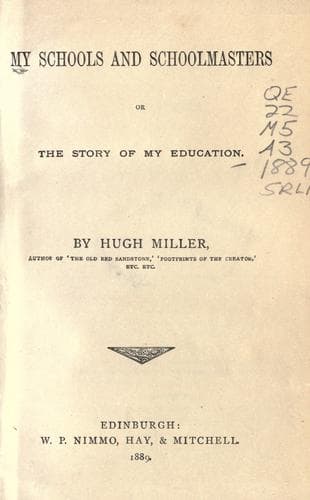
My Schools and Schoolmasters; Or, The Story of My EducationMiller, Hugh
Philosophy
My Schools and Schoolmasters; Or, The Story of My Education
Miller, Hugh
Education -- Scotland -- History -- 19th century; Geologists -- Scotland -- Biography; Miller, Hugh, 1802-1856 -- Knowledge and learning
was his business to disinter it; and while ordinary stone-cutters had to
repeat and re-repeat their lines and draughts, and had in this way
virtually to give to their work several surfaces in detail ere they
reached the true one, old John cut upon the true figure at once, and
made one surface serve for all. In building, too, he exercised a similar
power: he hammer-dressed his stones with fewer strokes than other
workmen, and in fitting the interspaces between stones already laid,
always picked from out of the heap at his feet the stone that exactly
fitted the place; while other operatives busied themselves in picking up
stones that were too small or too large; or, if they set themselves to
reduce the too large ones, reduced them too little or too much, and had
to fit and fit again. Whether building or hewing, John never seemed in a
hurry. He has been seen, when far advanced in life, working very
leisurely, as became his years, on the one side of a wall, and two stout
young fellows building against him on the other side--toiling,
apparently, twice harder than he, but the old man always contriving to
keep a little a-head of them both.
David Fraser I never saw; but as a hewer he was said considerably to
excel even his brother John. On hearing that it had been remarked among
a party of Edinburgh masons, that, though regarded as the first of
Glasgow stone-cutters, he would find in the eastern capital at least his
equals, he attired himself most uncouthly in a long-tailed coat of
tartan, and, looking to the life the untamed, untaught, conceited little
Celt, he presented himself on Monday morning, armed with a letter of
introduction from a Glasgow builder, before the foreman of an Edinburgh
squad of masons engaged upon one of the finer buildings at that time in
the course of erection. The letter specified neither his qualifications
nor his name: it had been written merely to secure for him the necessary
employment, and the necessary employment it did secure. The better
workmen of the party were engaged, on his arrival, in hewing columns,
each of which was deemed sufficient work for a week; and David was
asked, somewhat incredulously, by the foreman, "if he could hew?" "O
yes, _he thought_ he could hew." "Could he hew columns such as these!"
"O yes, _he thought_ he could hew columns such as these." A mass of
stone in which a possible column lay hid, was accordingly placed before
David, not under cover of the shed, which was already occupied by
workmen, but, agreeably to David's own request, directly in front of it,
where he might be seen by all, and where he straightway commenced a most
extraordinary course of antics. Buttoning his long tartan coat fast
around him, he would first look along the stone from the one end, anon
from the other, and then examine it in front and rear; or, quitting it
altogether for the time, he would take up his stand beside the other
workmen, and, after looking at them with great attention, return and
Public-domain text, read in full here on John Shaqi.
Reviews
Reviews
No reviews yet
Be the first to share your thoughts on this work.
Elsewhere in the archive
Join the Discussion
Join the discussion
Sign in to leave a comment or review.
Sign InorCreate an account