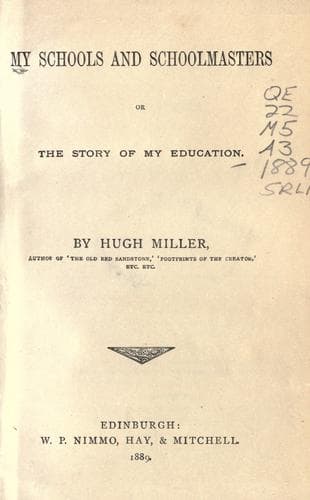
My Schools and Schoolmasters; Or, The Story of My EducationMiller, Hugh
Philosophy
My Schools and Schoolmasters; Or, The Story of My Education
Miller, Hugh
Education -- Scotland -- History -- 19th century; Geologists -- Scotland -- Biography; Miller, Hugh, 1802-1856 -- Knowledge and learning
somewhat meagre scenery of a sea-bottom in Gairloch, as seen by a human
eye submerged in from two to three fathoms of water.
There still continued to linger in this primitive district, at the time,
several curious arts and implements, that had long become obsolete in
most other parts of the Highlands, and of which the remains, if found in
England or the Low country, would have been regarded by the antiquary as
belonging to very remote periods. During the previous winter I had read
a little work descriptive of an ancient ship, supposed to be Danish,
which had been dug out of the silt of an English river, and which, among
other marks of antiquity, exhibited seams caulked with moss--a
peculiarity which had set at fault, it was said, the modern
ship-carpenter, in the chronology of his art, as he was unaware that
there had ever been a time when moss was used for such a purpose. On
visiting, however, a boat-yard at Gairloch, I found the Highland builder
engaged in laying a layer of dried moss, steeped in tar, along one of
his seams, and learned that such had been the practice of
boat-carpenters in that locality from time immemorial. I have said that
the little old Highlander of the solitary shieling, whom we met on first
commencing our quarrying labours beside his hut, was engaged in
stripping with a pocket-knife long slender filaments from off a piece of
moss-fir. He was employed in preparing these ligneous fibres for the
manufacture of a primitive kind of cordage, in large use among the
fishermen, and which possessed a strength and flexibility that could
scarce have been expected from materials of such venerable age and
rigidity as the roots and trunks of ancient trees, that had been locked
up in the peat-mosses of the district for mayhap a thousand years. Like
the ordinary cordage of the rope-maker, it consisted of three strands,
and was employed for haulsers, the cork-bauks of herring-nets, and the
lacing of sails. Most of the sails themselves were made, not of canvas,
but of a woollen stuff, the thread of which, greatly harder and stouter
than that of common plaid, had been spun on the distaff and spindle. As
hemp and flax must have been as rare commodities of old in the western
Highlands, and the Hebrides generally, as they both were thirty years
ago in Gairloch, whereas moss-fir must have been abundant, and sheep,
however coarse their fleeces, common enough, it seems not improbable
that the old Highland fleets that fought in the "Battle of the Bloody
Bay," or that, in troublous times, when Donald quarrelled with the king,
ravaged the coasts of Arran and Ayrshire, may been equipped with similar
sails and cordage. Scott describes the fleet of the "Lord of the Isles,"
in the days of the Bruce, as consisting of "proud galleys," "streamered
with silk and tricked with gold." I suspect he would have approved
himself a truer antiquary, though mayhap worse poet, had he described it
as composed of very rude carvels, caulked with moss, furnished with
Public-domain text, read in full here on John Shaqi.
Reviews
Reviews
No reviews yet
Be the first to share your thoughts on this work.
Elsewhere in the archive
Join the Discussion
Join the discussion
Sign in to leave a comment or review.
Sign InorCreate an account