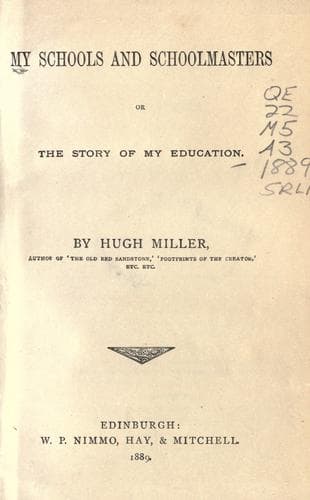
My Schools and Schoolmasters; Or, The Story of My EducationMiller, Hugh
Philosophy
My Schools and Schoolmasters; Or, The Story of My Education
Miller, Hugh
Education -- Scotland -- History -- 19th century; Geologists -- Scotland -- Biography; Miller, Hugh, 1802-1856 -- Knowledge and learning
sails of dun-coloured woollen stuff still redolent of the oil, and
rigged out with brown cordage formed of the twisted fibres of moss-fir.
The distaff and spindle was still, as I have said, in extensive use in
the district. In a scattered village in the neighbourhood of our
barrack, in which all the adult females were ceaselessly engaged in the
manufacture of yarn, there was not a single spinning-wheel. Nor, though
all its cottages had their little pieces of tillage, did it boast its
horse or plough. The cottars turned up the soil with the old Highland
implement, the _cass-chron_; and the necessary manure was carried to the
fields in spring, and the produce brought home in autumn, on the backs
of the women, in square wicker-work panniers, with slip-bottoms. How
these poor Highland women did toil! I have paused amid my labours under
the hot sun, to watch them as they passed, bending under their load of
peat or manure, and at the same time twirling the spindle as they crept
along, and drawing out the never-ending thread from the distaff stuck in
their girdles. Their appearance in most cases betrayed their life of
hardship. I scarce saw a Gairloch woman of the humbler class turned of
thirty, who was not thin, sallow, and prematurely old. The men, their
husbands and brothers, were by no means worn out with hard work. I have
seen them, time after time, sunning themselves on a mossy bank, when the
females were thus engaged; and used, with my brother-workmen--who were
themselves Celts, but of the industrious, hardworking type--to feel
sufficiently indignant at the lazy fellows. But the arrangement which
gave them rest, and their wives and sisters hard labour, seemed to be as
much the offspring of a remote age as the woollen sails and the moss-fir
cordage. Several other ancient practices and implements had at this time
just disappeared from the district. A good meal-mill of the modern
construction had superseded, not a generation before, several small
mills with horizontal water-wheels, of that rude antique type which
first supplanted the still more ancient handmill. These horizontal mills
still exist, however--at least they did so only two years ago--in the
gneiss region of Assynt. The antiquary sometimes forgets that, tested by
his special rules for determining periods, several ages may be found
contemporary in contiguous districts of the same country. I am old
enough to have seen the handmill at work in the north of Scotland; and
the traveller into the Highlands of western Sutherland might have
witnessed the horizontal mill in action only two years ago. But to the
remains of either, if dug out of the mosses or sand-hills of the
southern counties, we would assign an antiquity of centuries. In the
same way, the unglazed earthen pipkin, fashioned by the hand without the
assistance of the potter's wheel, is held to belong to the "bronze and
stone periods" of the antiquary; and yet my friend of the Doocot Cave,
Public-domain text, read in full here on John Shaqi.
Reviews
Reviews
No reviews yet
Be the first to share your thoughts on this work.
Elsewhere in the archive
Join the Discussion
Join the discussion
Sign in to leave a comment or review.
Sign InorCreate an account