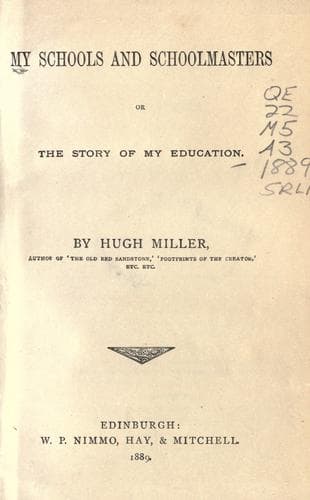
My Schools and Schoolmasters; Or, The Story of My EducationMiller, Hugh
Philosophy
My Schools and Schoolmasters; Or, The Story of My Education
Miller, Hugh
Education -- Scotland -- History -- 19th century; Geologists -- Scotland -- Biography; Miller, Hugh, 1802-1856 -- Knowledge and learning
always a frivolous, and often a very bad thing; but lonely Sabbath-walks
in a rural district--walks such as the poet Graham describes--are not
necessarily bad; and the Sabbatarians who urge that in all cases, men,
when not in church on the Sabbath, ought to be in their dwellings, must
know very little indeed of the "huts where poor men lie." In the mason's
barrack, or the farm-servant's bothy, it is often impossible to enjoy
the quiet of the Sabbath: the circumstances necessary to its enjoyment
must be sought in the open air, amid the recesses of some thick wood, or
along the banks of some unfrequented river, or on the brown wastes of
some solitary moor.
We had completed all our work ere Hallowday, and, after a journey of
nearly three days, I found myself once more at home, with the leisure of
the long happy winter before me. I still look lack on the experiences of
this year with a feeling of interest. I had seen in my boyhood, in the
interior of Sutherland, the Highlanders living in that condition of
comparative comfort which they enjoyed from shortly after the
suppression of the rebellion of 1745, and the abolition of the
hereditary jurisdictions, till the beginning of the present century, and
in some localities for ten or twelve years later. And here again I saw
them in a condition--the effect mainly of the introduction of the
extensive sheep-farm system into the interior of the country--which has
since become general over almost the entire Highlands, and of which the
result may be seen in the annual famines. The population, formerly
spread pretty equally over the country, now exists as a miserable
selvedge, stretched along its shores, dependent in most cases on
precarious fisheries, that prove remunerative for a year or two, and
disastrous for mayhap half-a-dozen; and able barely to subsist when
most successful, a failure in the potato crop, or in the expected return
of the herring shoals, at once reduces them to starvation. The grand
difference between the circumstances of the people of the Highlands in
the better time and the worse may be summed up in the one important
vocable--_capital_. The Highlander was never wealthy: the inhabitants of
a wild mountainous district, formed of the primary rocks, never are. But
he possessed, on the average, his six, or eight, or ten head of cattle,
and his small flock of sheep; and when, as sometimes happened in the
high-lying districts, the corn-crop turned out a failure, the sale of a
few cattle or sheep more than served to clear scores with the landlord,
and enabled him to purchase his winter and spring supply of meal in the
Lowlands. He was thus a capitalist, and possessed the capitalist's
peculiar advantage of not "living from hand to mouth," but on an
accumulated fund, which always stood between him and absolute want,
though not between him and positive hardship, and which enabled him to
rest, during a year of scarcity, on his own resources, instead of
Public-domain text, read in full here on John Shaqi.
Reviews
Reviews
No reviews yet
Be the first to share your thoughts on this work.
Elsewhere in the archive
Join the Discussion
Join the discussion
Sign in to leave a comment or review.
Sign InorCreate an account