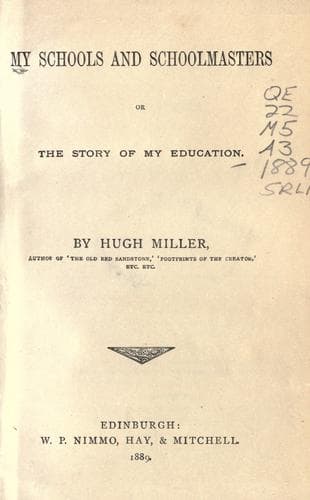
My Schools and Schoolmasters; Or, The Story of My EducationMiller, Hugh
Philosophy
My Schools and Schoolmasters; Or, The Story of My Education
Miller, Hugh
Education -- Scotland -- History -- 19th century; Geologists -- Scotland -- Biography; Miller, Hugh, 1802-1856 -- Knowledge and learning
throwing himself on the charity of his Lowland neighbours. Nay, in what
were emphatically termed "the dear years" of the beginning of the
present and latter half of the past century, the humble people of the
Lowlands, especially our Lowland mechanics and labourers, suffered more
than the crofters and _small_ farmers of the Highlands, and this mainly
from the circumstance, that as the failure of the crops which induced
the scarcity was a corn failure, not a failure of grass and pasture, the
humbler Highlanders had sheep and cattle, which continued to supply them
with food and raiment; while the humbler Lowlanders, depending on corn
almost exclusively, and accustomed to deal with the draper for their
articles of clothing, were reduced by the high price of provisions to
great straits. There took place, however, about the beginning of the
century, a mighty change, coincident with, and, to a certain extent, an
effect of, the wars of the first French Revolution. The price of
provisions rose in England and the Lowlands, and with the price of
provisions, the rent of land. The Highland proprietor naturally enough
set himself to determine how his rental also was to be increased; and,
as a consequence of the conclusion at which he arrived, the sheep-farm
and clearance system began. Many thousand Highlanders, ejected from
their snug holdings, employed their little capital in emigrating to
Canada and the States; and there, in most cases, the little capital
increased, and a rude plenty continues to be enjoyed by their
descendants. Many thousands more, however, fell down upon the coasts of
the country, and, on moss-covered moors or bare promontories, ill suited
to repay the labours of the agriculturist, commenced a sort of
amphibious life as crofters and fishermen. And, located on an ungenial
soil, and prosecuting with but indifferent skill a precarious trade,
their little capital dribbled out of their hands, and they became the
poorest of men. Meanwhile, in some parts of the Highlands and Islands a
busy commerce sprang up, which employed--much to the profit of the
landlords--many thousands of the inhabitants. The kelp manufacture
rendered inhospitable islets and tracts of bleak rocky shore, rich in
sea-weed, of as much value to the proprietors as the best land in
Scotland; and, under the impetus given by full employment, and, if not
ample, at least remunerative pay, population increased. Suddenly,
however, Free Trade, in its first approaches, destroyed the trade in
kelp; and then the discovery of a cheap mode of manufacturing soda out
of common salt secured its ruin beyond the power of legislation to
retrieve. Both the people and landlords experienced in the kelp
districts the evils which a ruined commerce always leaves behind it. Old
Highland families disappeared from amid the aristocracy and landowners
of Scotland; and the population of extensive islands and sea-boards of
the country, from being no more than adequate, suddenly became
oppressively redundant.
Public-domain text, read in full here on John Shaqi.
Reviews
Reviews
No reviews yet
Be the first to share your thoughts on this work.
Elsewhere in the archive
Join the Discussion
Join the discussion
Sign in to leave a comment or review.
Sign InorCreate an account