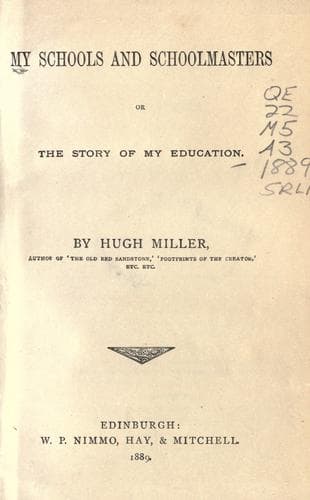
My Schools and Schoolmasters; Or, The Story of My EducationMiller, Hugh
Philosophy
My Schools and Schoolmasters; Or, The Story of My Education
Miller, Hugh
Education -- Scotland -- History -- 19th century; Geologists -- Scotland -- Biography; Miller, Hugh, 1802-1856 -- Knowledge and learning
sessile cones along their sides--and ornately tatooed sigillaria, fluted
like columns, and with vertical rows of leaves bristling over their
stems and larger branches. Such were some of the dreams in which I began
at this period for the first time to indulge; nor have they, like the
other dreams of youth, passed away. The aged poet has not unfrequently
to complain, that as he rises in years, his "visions float less palpably
before him." Those, on the contrary, which science conjures up, grow in
distinctness, as, in the process of slow acquirement, form after form is
evoked from out the obscurity of the past, and one restoration added to
another.
There were at this time several collier villages in the neighbourhood of
Edinburgh, which have since disappeared. They were situated on what were
called the "edge-coals"--those steep seams of the Mid-Lothian Coal
Basin which, lying low in the system, have got a more vertical tilt
against the trap eminences of the south and west than the upper seams in
the middle of the field, and which, as they could not be followed in
their abrupt descent beyond a certain depth, are now regarded, for at
least the practical purposes of the miner, and until the value of coal
shall have risen considerably, as wrought out. One of these villages,
whose foundations can no longer be traced, occurred in the immediate
vicinity of Niddry Mill. It was a wretched assemblage of dingy,
low-roofed, tile-covered hovels, each of which perfectly resembled all
the others, and was inhabited by a rude and ignorant race of men, that
still bore about them the soil and stain of recent slavery. Curious as
the fact may seem, all the older men of that village, though situated
little more than four miles from Edinburgh, had been born slaves. Nay,
eighteen years later (in 1842), when Parliament issued a commission to
inquire into the nature and results of female labour in the coal-pits of
Scotland, there was a collier still living that had never been twenty
miles from the Scottish capital, who could state to the Commissioners
that both his father and grandfather had been slaves--that he himself
had been born a slave--and that he had wrought for years in a pit in the
neighbourhood of Musselburgh ere the colliers got their freedom. Father
and grandfather had been parishioners of the late Dr. Carlyle of
Inveresk. They were cotemporary with Chatham and Cowper, and Burke and
Fox; and at a time when Granville Sharpe could have stepped forward and
effectually protected the runaway negro who had taken refuge from the
tyranny of his master in a British port, no man could have protected
_them_ from the Inveresk laird, their proprietor, had they dared to
exercise the right, common to all Britons besides, of removing to some
other locality, or of making choice of some other employment. Strange
enough, surely, that so entire a fragment of the barbarous past should
have been thus dovetailed into the age not yet wholly passed away! I
Public-domain text, read in full here on John Shaqi.
Reviews
Reviews
No reviews yet
Be the first to share your thoughts on this work.
Elsewhere in the archive
Join the Discussion
Join the discussion
Sign in to leave a comment or review.
Sign InorCreate an account