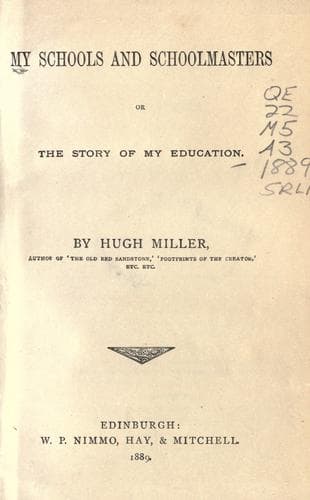
My Schools and Schoolmasters; Or, The Story of My EducationMiller, Hugh
Philosophy
My Schools and Schoolmasters; Or, The Story of My Education
Miller, Hugh
Education -- Scotland -- History -- 19th century; Geologists -- Scotland -- Biography; Miller, Hugh, 1802-1856 -- Knowledge and learning
regard it as one of the more singular circumstances of my life, that I
should have conversed with Scotchmen who had been born slaves. The
collier women of this village--poor over-toiled creatures, who carried
up all the coal from underground on their backs, by a long turnpike
stair inserted in one of the shafts--continued to bear more of the marks
of serfdom still about them than even the men. How these poor women did
labour, and how thoroughly, even at this time, were they characterized
by the slave nature! It has been estimated by a man who knew them
well--Mr. Robert Bald--that one of their ordinary day's work was equal
to the carrying of a hundredweight from the level of the sea to the top
of Ben Lomond. They were marked by a peculiar type of mouth, by which I
learned to distinguish them from all the other females of the country.
It was wide, open, thick-lipped, projecting equally above and below, and
exactly resembled that which we find in the prints given of savages in
their lowest and most degraded state, in such narratives of our modern
voyagers as, for instance, the "Narrative of Captain Fitzroy's Second
Voyage of the Beagle." During, however, the lapse of the last twenty
years this type of mouth seems to have disappeared in Scotland. It was
accompanied by traits of almost infantile weakness. I have seen these
collier women crying like children, when toiling under their load along
the upper rounds of the wooden stair that traversed the shaft; and then
returning, scarce a minute after, with the empty creel, singing with
glee. The collier houses were chiefly remarkable for being all alike,
outside and in; all were equally dingy, dirty, naked, and uncomfortable.
I first learned to suspect, in this rude village, that the democratic
watchword, "Liberty and Equality," is somewhat faulty in its philosophy.
Slavery and Equality would be nearer the mark. Wherever there is
liberty, the original differences between man and man begin to manifest
themselves in their external circumstances, and the equality
straightway ceases. It is through slavery that equality, among at least
the masses, is to be fully attained.[8]
Public-domain text, read in full here on John Shaqi.
Reviews
Reviews
No reviews yet
Be the first to share your thoughts on this work.
Elsewhere in the archive
Join the Discussion
Join the discussion
Sign in to leave a comment or review.
Sign InorCreate an account