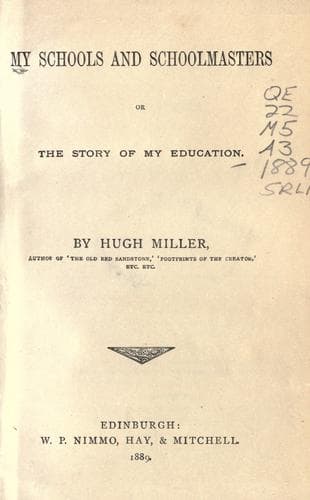
My Schools and Schoolmasters; Or, The Story of My EducationMiller, Hugh
Philosophy
My Schools and Schoolmasters; Or, The Story of My Education
Miller, Hugh
Education -- Scotland -- History -- 19th century; Geologists -- Scotland -- Biography; Miller, Hugh, 1802-1856 -- Knowledge and learning
I found but little intelligence in the neighbourhood, among even the
villagers and country people, that stood on a higher platform than the
colliers. The fact may be variously accounted for; but so it is, that
though there is almost always more than the average amount of knowledge
and acquirement amongst the mechanics of large towns, the little hamlets
and villages by which they are surrounded are usually inhabited by a
class considerably below the average. In M. Quetelet's interesting
"Treatise on Man," we find a series of maps given, which, based on
extensive statistical tables, exhibit by darker and lighter shadings the
moral and intellectual character of the people in the various districts
of the countries which they represent. In one map, for instance,
representative of the state of education in France, while certain
well-taught provinces are represented by a bright tint, as if enjoying
the light, there are others, in which great ignorance obtains, that
exhibit a deep shade of blackness, as if a cloud rested over them; and
the general aspect of the whole is that of a landscape seen from a
hill-top in a day of dappled light and shadow. There are certain minuter
shadings, however, by which certain curious facts might be strikingly
represented to the eye in this manner, for which statistical tables
furnish no adequate basis, but which men who have seen a good deal of
the people of a country might be able to give in a manner at least
approximately correct. In a shaded map representative of the
intelligence of Scotland, I would be disposed--sinking the lapsed
classes, or representing them merely by a few such dark spots as mottle
the sun--to represent the large towns as centres of focal brightness;
but each of these focal centres I would encircle with a halo of darkness
considerably deeper in shade than the medium spaces beyond. I found that
in the tenebrious halo of the Scottish capital there existed,
independently of the ignorance of the poor colliers, three distinct
elements. A considerable proportion of the villagers were farm-servants
in the decline of life, who, unable any longer to procure, as in their
days of unbroken strength, regular engagements from the farmers of the
district, supported themselves as occasional labourers. And they, of
course, were characterized by the ignorance of their class. Another
portion of the people were carters--employed mainly, in these times, ere
the railways began, in supplying the Edinburgh coal-market, and in
driving building materials into the city from the various quarries. And
carters as a class, like all who live much in the society of horses, are
invariably ignorant and unintellectual. A third, but greatly smaller
portion than either of the other two, consisted of mechanics; but it was
only mechanics of an inferior order, that remained outside the city to
work for carters and labourers: the better skilled, and, as to a certain
extent the terms are convertible, the more intelligent mechanics found
Public-domain text, read in full here on John Shaqi.
Reviews
Reviews
No reviews yet
Be the first to share your thoughts on this work.
Elsewhere in the archive
Join the Discussion
Join the discussion
Sign in to leave a comment or review.
Sign InorCreate an account