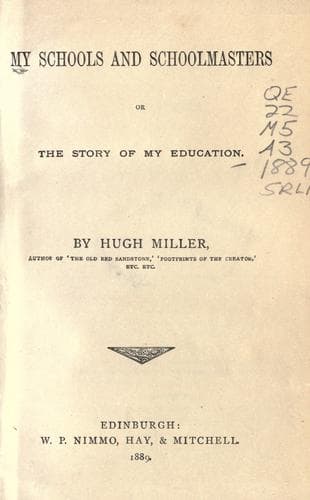
My Schools and Schoolmasters; Or, The Story of My EducationMiller, Hugh
Philosophy
My Schools and Schoolmasters; Or, The Story of My Education
Miller, Hugh
Education -- Scotland -- History -- 19th century; Geologists -- Scotland -- Biography; Miller, Hugh, 1802-1856 -- Knowledge and learning
against them: there will be a continual ebb and flow, like that of the
sea, but no general advance; and the sooner that the like of you and I
get out of the rough conflict and jostle of the tideway, and set
ourselves to labour apart on our own internal resources, it will be all
the better for us." William, however, did not give up his clerkship; and
I daresay the sort of treatment which I had received at the hands of my
fellow-workmen made me express myself rather strongly on the subject;
but the actual history of the numerous strikes and combinations which
have taken place during the quarter of a century and more which has
since intervened, is of a kind not in the least suited to modify my
views. There _is_ a want of judicious leadership among our working men;
and such of the autobiographies of the class as are able and interesting
enough to obtain a hearing of their authors show, I am inclined to
think, how this takes place. Combination is first brought to bear among
them against the men, their fellows, who have vigour enough of intellect
to think and act for themselves; and such always is the character of the
born leader: these true leaders are almost always forced into the
opposition; and thus separating between themselves and the men fitted by
nature to render them formidable, they fall under the direction of mere
chatterers and stump orators, which is in reality no direction at all.
The author of the "Working Man's Way in the World"--evidently a very
superior man--had, he tells us, to quit at one time his employment,
overborne by the senseless ridicule of his brother workmen. Somerville
states in his Autobiography, that, both as a labouring man and a
soldier, it was from the hands of his comrades that--save in one
memorable instance--he had experienced all the tyranny and oppression of
which he had been the victim. Nay, Benjamin Franklin himself was deemed
a much more ordinary man in the printing-house in Bartholomew Close,
where he was teased and laughed at as the _Water-American_, than in the
House of Representatives, the Royal Society, or the Court of France.
The great Printer, though recognised by accomplished politicians as a
profound statesman, and by men of solid science as "the most rational of
the philosophers," was regarded by his poor brother compositors as
merely an odd fellow, who did not conform to their drinking usages, and
whom it was therefore fair to tease and annoy as a contemner of the
_sacrament_ of the _chapel_.[9]
Public-domain text, read in full here on John Shaqi.
Reviews
Reviews
No reviews yet
Be the first to share your thoughts on this work.
Elsewhere in the archive
Join the Discussion
Join the discussion
Sign in to leave a comment or review.
Sign InorCreate an account