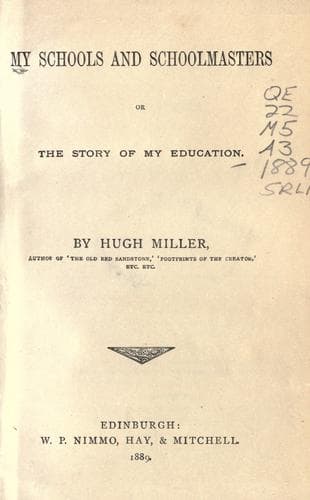
My Schools and Schoolmasters; Or, The Story of My EducationMiller, Hugh
Philosophy
My Schools and Schoolmasters; Or, The Story of My Education
Miller, Hugh
Education -- Scotland -- History -- 19th century; Geologists -- Scotland -- Biography; Miller, Hugh, 1802-1856 -- Knowledge and learning
The life of my friend was, however, pitched on a better and higher tone
than that of most of his brother unionists. It was intellectual and
moral, and its happier hours were its hours of quiet self-improvement,
when, throwing himself on the resources within, he forgot for the time
the unions and combinations that entailed upon him much troublesome
occupation, but never did him any service. I regretted, however, to find
that a distrust of his own powers was still growing upon him, and
narrowing his circle of enjoyment. On asking him whether he still amused
himself with his flute, he turned, after replying with a brief "O no!"
to a comrade with whom he had lived for years, and quietly said to him,
by way of explaining the question, "Robert, I suppose you don't know I
was once a grand flute-player!" And sure enough Robert did not know. He
had given up, too, his water-colour drawing, in which his taste was
decidedly fine; and even in oils, with which he still occasionally
engaged himself, instead of casting himself full on nature, as at an
earlier period, he had become a copyist of the late Rev. Mr. Thomson of
Duddingstone, at that time in the full blow of his artistic reputation;
nor could I see that he copied him well. I urged and remonstrated, but
to no effect. "Ah, Miller," he has said, "what matters it how I amuse
myself? You have stamina in you, and will force your way; but I want
strength: the world will never hear of me." That overweening conceit
which seems but natural to the young man as a playful disposition to the
kitten, or a soft and timid one to the puppy, often assumes a
ridiculous, and oftener still an unamiable, aspect. And yet, though it
originates many very foolish things, it seems to be in itself, like the
fanaticism of the Teetotaller, a wise provision, which, were it not made
by nature, would leave most minds without spring enough to effect, with
the required energy, the movements necessary to launch them fairly into
busy or studious life. The sobered man of mature age who has learned
pretty correctly to take the measure of himself, has usually acquired
both habits and knowledge that assist him in urging his onward way, and
the moving force of necessity always presses him onward from behind; but
the exhilarating conviction of being born to superior parts, and to do
something astonishingly clever, seems necessary to the young man; and
when I see it manifesting itself, if not very foolishly or very
offensively, I usually think of my poor friend William Ross, who was
unfortunate enough wholly to want it; and extend to it a pretty ample
toleration. Ultimately my friend gave up painting, and restricted
himself to the ornamental parts of his profession, of which he became
very much a master. In finishing a ceiling in oils, upon which he had
represented in bold relief some of the ornately sculptured foliage of
the architect, the gentleman for whom he wrought (the son-in-law of a
Public-domain text, read in full here on John Shaqi.
Reviews
Reviews
No reviews yet
Be the first to share your thoughts on this work.
Elsewhere in the archive
Join the Discussion
Join the discussion
Sign in to leave a comment or review.
Sign InorCreate an account