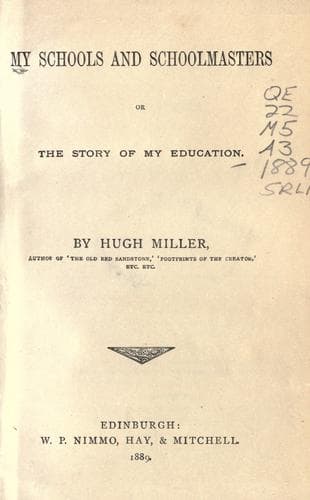
My Schools and Schoolmasters; Or, The Story of My EducationMiller, Hugh
Philosophy
My Schools and Schoolmasters; Or, The Story of My Education
Miller, Hugh
Education -- Scotland -- History -- 19th century; Geologists -- Scotland -- Biography; Miller, Hugh, 1802-1856 -- Knowledge and learning
Partly through my friend, but in part also from the circumstance that I
retained a measure of intimacy with such of my schoolfellows as had
subsequently prosecuted their education at college, I was acquainted,
during the later years in which I wrought as a mason, with a good many
university-taught lads; and I sometimes could not avoid comparing them
in my mind with working men of, as nearly as I could guess, the same
original calibre. I did not always find that general superiority on the
side of the scholar which the scholar himself usually took for granted.
What he had specially studied he knew, save in rare and exceptional
cases, better than the working man; but while the student had been
mastering his Greek and Latin, and expatiating in Natural Philosophy and
the Mathematics, the working man, if of an inquiring mind, had been
doing something else; and it is at least a fact, that all the great
readers of my acquaintance at this time--the men most extensively
acquainted with English literature--were not the men who had received
the classical education. On the other hand, in framing an argument, the
advantage lay with the scholars. In that common sense, however, which
reasons but does not argue, and which enables men to pick their stepping
prudently through the journey of life, I found that the classical
education gave no superiority whatever; nor did it appear to form so
fitting an introduction to the realities of business as that course of
dealing with things tangible and actual in which the working man has to
exercise his faculties, and from which he derives his experience. One
cause of the over-low estimate which the classical scholar so often
forms of the intelligence of that class of the people to which our
skilled mechanics belong, arises very much from the forwardness of a set
of blockheads who are always sure to obtrude themselves upon his notice,
and who come to be regarded by him as average specimens of their order.
I never yet knew a truly intelligent mechanic obtrusive. Men of the
stamp of my two uncles, and of my friend William Ross, never press
themselves on the notice of the classes above them. A minister newly
settled in a charge, for instance, often finds that it is the dolts of
his flock that first force themselves upon his acquaintance. I have
heard the late Mr. Stewart of Cromarty remark, that the humbler
dunderheads of the parish had all introduced themselves to his
acquaintance long ere he found out its clever fellows. And hence often
sad mistakes on the part of a clergyman in dealing with the people. It
seems never to strike him that there may be among them men of his own
calibre, and, in certain practical departments, even better taught than
he; and that this superior class is always sure to lead the others. And
in preaching down to the level of the men of humbler capacity, he fails
often to preach to men of any capacity at all, and is of no use. Some of
the clerical contemporaries of Mr.
Public-domain text, read in full here on John Shaqi.
Reviews
Reviews
No reviews yet
Be the first to share your thoughts on this work.
Elsewhere in the archive
Join the Discussion
Join the discussion
Sign in to leave a comment or review.
Sign InorCreate an account