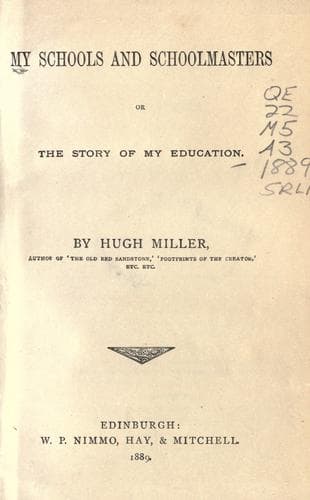
My Schools and Schoolmasters; Or, The Story of My EducationMiller, Hugh
Philosophy
My Schools and Schoolmasters; Or, The Story of My Education
Miller, Hugh
Education -- Scotland -- History -- 19th century; Geologists -- Scotland -- Biography; Miller, Hugh, 1802-1856 -- Knowledge and learning
Stewart used to allege that, in
exercising his admirable faculties in the theological field, he
sometimes forgot to lower himself to his people, and so preached over
their heads. And at times, when they themselves came to occupy his
pulpit, as occasionally happened, they addressed to the congregation
sermons quite simple enough for even children to comprehend. I taught at
the time a class of boys in the Cromarty Sabbath-school, and invariably
found on these occasions, that while the memories of my pupils were
charged to the full with the striking thoughts and graphic illustrations
of the very elaborate discourses deemed too high for them, they
remembered of the very simple ones, specially lowered to suit narrow
capacities, not a single word or note. All the attempts at originating a
cheap literature that have failed, have been attempts pitched too low:
the higher-toned efforts have usually succeeded. If the writer of these
chapters has been in any degree successful in addressing himself as a
journalist to the Presbyterian people of Scotland, it has always been,
not by writing _down_ to them, but by doing his best on all occasions to
write _up_ to them. He has ever thought of them as represented by his
friend William, his uncles, and his Cousin George--by shrewd old John
Fraser, and his reckless though very intelligent acquaintance Cha; and
by addressing to them on every occasion as good sense and as solid
information as he could possibly muster, he has at times succeeded in
catching their ear, and perhaps, in some degree, in influencing their
judgment.
FOOTNOTE:
[10] The extreme picturesqueness of these fires--in part a consequence
of the great height and peculiar architecture of the buildings which
they destroyed--caught the nice eye of Sir Walter Scott. "I can
conceive," we find him saying, in one of his letters of the period, "no
sight more grand or terrible than to see these lofty buildings on fire
from top to bottom, vomiting out flames, like a volcano, from every
aperture, and finally crashing down one after another, into an abyss of
fire, which resembled nothing but hell; for there were vaults of wine
and spirits which set up huge jets of flames whenever they were called
into activity by the fall of these massive fragments. Between the corner
of the Parliament Square and the Tron Church, all is destroyed excepting
some new buildings at the lower extremity."
CHAPTER XVII.
"Beware, Lorenzo, a slow, sudden death."--YOUNG.
Public-domain text, read in full here on John Shaqi.
Reviews
Reviews
No reviews yet
Be the first to share your thoughts on this work.
Elsewhere in the archive
Join the Discussion
Join the discussion
Sign in to leave a comment or review.
Sign InorCreate an account