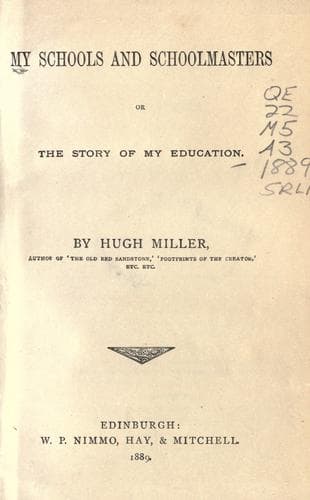
My Schools and Schoolmasters; Or, The Story of My EducationMiller, Hugh
Philosophy
My Schools and Schoolmasters; Or, The Story of My Education
Miller, Hugh
Education -- Scotland -- History -- 19th century; Geologists -- Scotland -- Biography; Miller, Hugh, 1802-1856 -- Knowledge and learning
There was one special subject which my friend, in our quiet evening
walks, used to urge seriously upon my attention. He had thrown up, under
strong religious impressions, what promised to be so good a business,
that in two years he had already saved money enough to meet the expenses
of a college course of education. And assuredly, never did man determine
on entering the ministry with views more thoroughly disinterested than
his. Patronage ruled supreme in the Scottish Establishment at the time;
and my friend had no influence and no patron; but he could not see his
way clear to join with the Evangelical Dissenters or the Secession; and
believing that the most important work on earth is the work of saving
souls, he had entered on his new course in the full conviction that, if
God had work for him of this high character to do, He would find him an
opportunity of doing it. And now, thoroughly in earnest, and as part of
the special employment to which he had devoted himself, he set himself
to press upon my attention the importance, in their personal bearing, of
religious concerns.
I was not unacquainted with the standard theology of the Scottish
Church. In the parish school I had, indeed, acquired no ideas on the
subject; and though I now hear a good deal said, chiefly with a
controversial bearing, about the excellent religious influence of our
parochial seminaries, I never knew any one who owed other than the
merest smattering of theological knowledge to these institutions, and
not a single individual who had ever derived from them any tincture,
even the slightest, of religious feeling. In truth, during almost the
whole of the last century, and for at least the first forty years of the
present, the people of Scotland were, with all their faults,
considerably more Christian than the larger part of their schoolmasters.
So far as I can remember, I carried in my memory from school only a
single remark at all theological in its character, and it was of a kind
suited rather to do harm than good. In reading in the class one Saturday
morning a portion of the Hundred and Nineteenth Psalm, I was told by the
master that that ethical poem was a sort of alphabetical acrostic--a
circumstance, he added, that accounted for its broken and inconsecutive
character as a composition. Chiefly, however, from the Sabbath-day
catechizings to which I had been subjected during boyhood by my uncles,
and latterly from the old divines, my Uncle Sandy's favourites, and from
the teachings of the pulpit, I had acquired a considerable amount of
religious knowledge. I had thought, too, a good deal about some of the
peculiar doctrines of Calvinism, in their character as abstruse
positions--such as the doctrine of the Divine decrees, and of man's
inability to assume the initiative in the work of his own conversion. I
had, besides, a great admiration of the Bible, especially of its
narrative and poetical parts; and could scarce give strong enough
Public-domain text, read in full here on John Shaqi.
Reviews
Reviews
No reviews yet
Be the first to share your thoughts on this work.
Elsewhere in the archive
Join the Discussion
Join the discussion
Sign in to leave a comment or review.
Sign InorCreate an account