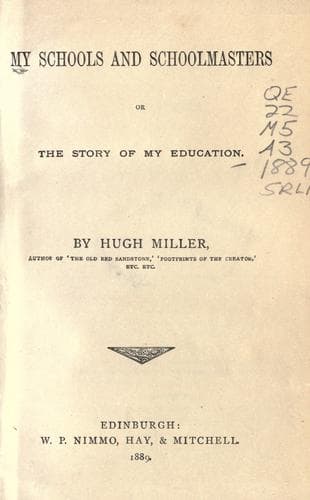
My Schools and Schoolmasters; Or, The Story of My EducationMiller, Hugh
Philosophy
My Schools and Schoolmasters; Or, The Story of My Education
Miller, Hugh
Education -- Scotland -- History -- 19th century; Geologists -- Scotland -- Biography; Miller, Hugh, 1802-1856 -- Knowledge and learning
That middle ground I now succeeded in finding. It is at once delicate
and dangerous to speak of one's own spiritual condition, or of the
emotional sentiments on which one's conclusions regarding it are often
so doubtfully founded. Egotism in the religious form is perhaps more
tolerated than in any other; but it is not on that account less perilous
to the egotist himself. There need be, however, less delicacy in
speaking of one's beliefs than of one's feelings; and I trust I need not
hesitate to say, that I was led to see at this time, through the
instrumentality of my friend, that my theologic system had previously
wanted a central object, to which the heart, as certainly as the
intellect, could attach itself; and that the true centre of an efficient
_Christianity_ is, as the name ought of itself to indicate, "the Word
made Flesh." Around this central sun of the Christian
system--appreciated, however, not as a _doctrine_ which is a mere
abstraction, but as a Divine Person--so truly Man, that the affections
of the human heart can lay hold upon Him, and so truly God, that the
mind, through faith, can at all times and in all places be brought into
direct contact with Him--all that is really religious takes its place in
a subsidiary and subordinate relation. I say subsidiary and subordinate.
The Divine Man is the great attractive centre, the sole gravitating
point of a system which owes to Him all its coherency, and which would
be but a chaos were He away. It seems to be the existence of the human
nature in this central and paramount object that imparts to
Christianity, in its subjective character, its peculiar power of
influencing and controlling the human mind. There may be men who,
through a peculiar idiosyncrasy of constitution, are capable of loving,
after a sort, a mere abstract God, unseen and inconceivable; though, as
shown by the air of sickly sentimentality borne by almost all that has
been said and written on the subject, the feeling in its true form must
be a very rare and exceptional one. In all my experience of men, I never
knew a genuine instance of it The love of an abstract God seems to be as
little natural to the ordinary human constitution as the love of an
abstract sun or planet. And so it will be found, that in all the
religions that have taken strong hold of the mind of man, the element of
a vigorous humanity has mingled, in the character of its gods, with the
theistic element. The gods of classic mythology were simply powerful men
set loose from the tyranny of the physical laws; and, in their purely
human character, as warm friends and deadly enemies, they were both
feared and loved. And so the belief which bowed at their shrines ruled
the old civilized world for many centuries. In the great ancient
mythologies of the East--Buddhism and Brahmanism--both very influential
forms of belief--we have the same elements, genuine humanity added to
god-like power. In the faith of the Moslem, the human character of the
Public-domain text, read in full here on John Shaqi.
Reviews
Reviews
No reviews yet
Be the first to share your thoughts on this work.
Elsewhere in the archive
Join the Discussion
Join the discussion
Sign in to leave a comment or review.
Sign InorCreate an account