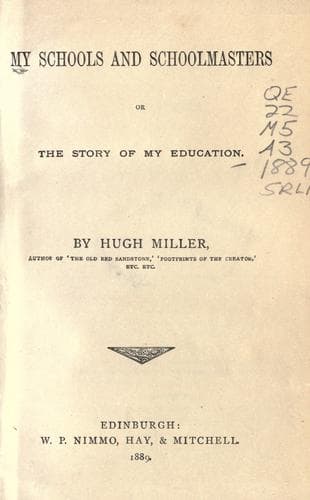
My Schools and Schoolmasters; Or, The Story of My EducationMiller, Hugh
Philosophy
My Schools and Schoolmasters; Or, The Story of My Education
Miller, Hugh
Education -- Scotland -- History -- 19th century; Geologists -- Scotland -- Biography; Miller, Hugh, 1802-1856 -- Knowledge and learning
man Mahommed, elevated to an all-potential viceregency in things sacred,
gives great strength to what without it would be but a weak theism.
Literally it is Allah's supreme prophet that maintains for Allah himself
a place in the Mahommedan mind. Again, in Popery we find an excess of
humanity scarce leas great than in the classical mythology itself, and
with nearly corresponding results. Though the Virgin Mother takes, as
queen of heaven, a first place in the scheme, and forms in that
character a greatly more interesting goddess than any of the old ones
who counselled Ulysses, or responded to the love of Anchises or of
Endymion, she has to share her empire with the minor saints, and to
recognise in them a host of rivals. But undoubtedly to this popular
element Popery owes not a little of its indomitable strength. In,
however, all these forms of religion, whether inherently false from the
beginning, or so overlaid in some after stage by the fictitious and the
untrue as to have their original substratum of truth covered up by error
and fable, there is such a want of coherency between the theistic and
human elements, that we always find them undergoing a process of
separation. We see the human element ever laying hold on the popular
mind, and there manifesting itself in the form of a vigorous
superstition; and the theistic element, on the other hand, recognised by
the cultivated intellect as the exclusive and only element, and
elaborated into a sort of natural theology, usually rational enough in
its propositions, but for any practical purpose always feeble and
inefficient. Such a separation of the two elements took place of old in
the ages of the classical mythology; and hence the very opposite
characters of the wild but genial and popular fables so exquisitely
adorned by the poets, and the rational but uninfluential doctrines
received by a select few from the philosophers. Such a separation took
place, too, in France in the latter half of the last century; and still
on the European Continent generally do we find this separation
represented by the assertors of a weak theism on the one hand, and of a
superstitious saint-worship on the other. In the false or corrupted
religions, the two indispensable elements of Divinity and Humanity
appear as if blended together by a mere mechanical process; and it is
their natural tendency to separate, through a sort of subsidence on the
part of the human element from the theistic one, as if from some lack of
the necessary affinities. In Christianity, on the other hand, when
existing in its integrity as the religion of the New Testament, the
union of the two elements is complete: it partakes of the nature, not of
a mechanical, but of a chemical mixture; and its great central
doctrine--the true Humanity and true Divinity of the Adorable
Saviour--is a truth equally receivable by at once the humblest and the
loftiest intellects. Poor dying children possessed of but a few simple
Public-domain text, read in full here on John Shaqi.
Reviews
Reviews
No reviews yet
Be the first to share your thoughts on this work.
Elsewhere in the archive
Join the Discussion
Join the discussion
Sign in to leave a comment or review.
Sign InorCreate an account