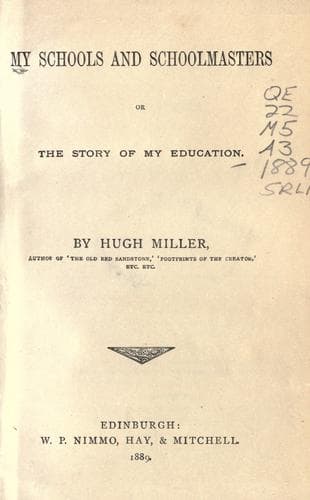
My Schools and Schoolmasters; Or, The Story of My EducationMiller, Hugh
Philosophy
My Schools and Schoolmasters; Or, The Story of My Education
Miller, Hugh
Education -- Scotland -- History -- 19th century; Geologists -- Scotland -- Biography; Miller, Hugh, 1802-1856 -- Knowledge and learning
goodness of God, and when what the Saviour did and suffered seems of
efficacy enough to blot out the guilt of every offence. It is when the
minor lights of comfort are extinguished that the Sun of Righteousness
shines forth, and more than compensates for them all.
The opinions which I formed at this time on this matter of prime
importance I found no after occasion to alter or modify. On the
contrary, in passing from the subjective to the objective view, I have
seen the doctrine of the union of the two natures greatly confirmed. The
truths of geology appear destined to exercise in the future no
inconsiderable influence on natural theology; and with this especial
doctrine they seem very much in accordance. Of that long and stately
march of creation with which the records of the stony science bring us
acquainted, the distinguishing characteristic is progress. There appears
to have been a time when there existed on our planet only dead matter
unconnected with vitality; and then a time in which plants and animals
of a low order began to be, but in which even fishes, the humblest of
the vertebrata, were so rare and exceptionable, that they occupied a
scarce appreciable place in Nature. Then came an age of fishes huge of
size, and that to the peculiar ichthyic organization added certain
well-marked characteristics of the reptilian class immediately above
them. And then, after a time, during which the reptile had occupied a
place as inconspicuous as that occupied by the fish in the earlier
periods of animal life, an age of reptiles of vast bulk and high
standing was ushered in. And when, in the lapse of untold ages, _it_
also had passed away, there succeeded an age of great mammals.
Molluscs, fishes, reptiles, mammals, had each in succession their
periods of vast extent; and then there came a period that differed even
more, in the character of its master-existence, from any of these
creations, than they, with their many vitalities, had differed from the
previous inorganic period in which life had not yet begun to be. The
human period began--the period of a fellow-worker with God, created in
God's own image. The animal existences of the previous ages formed, if I
may so express myself, mere figures in the landscapes of the great
garden which they inhabited. Man, on the other hand, was placed in it to
"keep and to dress it;" and such has been the effect of his labours,
that they have altered and improved the face of whole continents. Our
globe, even as it might be seen from the moon, testifies, over its
surface, to that unique nature of man, unshared in by any of the
inferior animals, which renders him, in things physical and natural, a
fellow-worker with the Creator who first produced it. And of the
identity of at least his intellect with that of his Maker, and, of
consequence, of the integrity of the revelation which declares that he
was created in God's own image, we have direct evidence in his ability
Public-domain text, read in full here on John Shaqi.
Reviews
Reviews
No reviews yet
Be the first to share your thoughts on this work.
Elsewhere in the archive
Join the Discussion
Join the discussion
Sign in to leave a comment or review.
Sign InorCreate an account