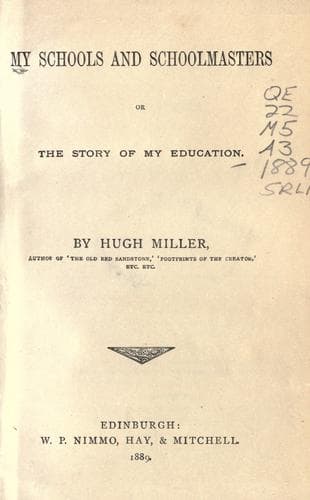
My Schools and Schoolmasters; Or, The Story of My EducationMiller, Hugh
Philosophy
My Schools and Schoolmasters; Or, The Story of My Education
Miller, Hugh
Education -- Scotland -- History -- 19th century; Geologists -- Scotland -- Biography; Miller, Hugh, 1802-1856 -- Knowledge and learning
This surely is a striking story; but the commonplace remark based upon
it by the philosopher is greatly less so. Men who have loved _do_ often
learn to hate the object of their affections; and men who have hated
sometimes learn to love: but the portion of the anecdote specially
worthy of remark appears to be that which, dwelling on the o'ermastering
remorse and sorrow of the rescued soldier, shows how effectually his
poor dead comrade had, by dying for him "while he was yet his enemy,"
"heaped coals of fire upon his head." And such seems to be one of the
leading principles on which, with a Divine adaptation to the heart of
man, the scheme of Redemption has been framed. The Saviour approved his
love, "in that while we were yet sinners, He died for us." There is an
inexpressibly great power in this principle; and many a deeply-stirred
heart has felt it to its core. The theologians have perhaps too
frequently dwelt on the Saviour's vicarious satisfaction for human sin
in its relation to the offended justice of the Father. How, or on what
principle, the Father was satisfied, I know not, and may never know. The
enunciation regarding vicarious satisfaction may be properly received in
faith as a _fact_, but, I suspect, not properly reasoned upon until we
shall be able to bring the moral sense of Deity, with its requirements,
within the limits of a small and trivial logic. But the thorough
adaptation of the scheme to man's nature is greatly more appreciable,
and lies fully within the reach of observation and experience. And how
thorough that adaptation is, all who have really looked at the matter
ought to be competent to say. Does an earthly priesthood, vested with
alleged powers to interpose between God and man, always originate an
ecclesiastical tyranny, which has the effect, in the end, of shutting up
the mass of men from their Maker?--here is there a High Priest passed
into the heavens--the only Priest whom the evangelistic Protestant
recognises as really such--to whom, in his character of Mediator between
God and man, all may apply, and before whom there need be felt none of
that abject prostration of the spirit and understanding which man always
experiences when he bends before the merely human priest. Is
self-righteousness the besetting infirmity of the religious man?--in the
scheme of vicarious righteousness it finds no footing. The
self-approving Pharisee must be content to renounce his own merits, ere
he can have part or lot in the fund of merit which alone avails; and yet
without personal righteousness he can have no evidence whatever that he
has an interest in the all-prevailing imputed righteousness. But it is
in the closing scene of life, when man's boasted virtues become so
intangible in his estimation that they elude his grasp, and sins and
shortcomings, little noted before, start up around him like spectres,
that the scheme of Redemption appears worthy of the infinite wisdom and
Public-domain text, read in full here on John Shaqi.
Reviews
Reviews
No reviews yet
Be the first to share your thoughts on this work.
Elsewhere in the archive
Join the Discussion
Join the discussion
Sign in to leave a comment or review.
Sign InorCreate an account