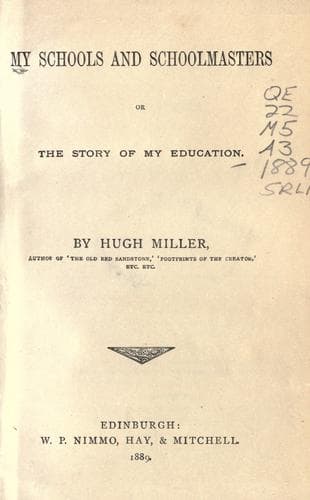
My Schools and Schoolmasters; Or, The Story of My EducationMiller, Hugh
Philosophy
My Schools and Schoolmasters; Or, The Story of My Education
Miller, Hugh
Education -- Scotland -- History -- 19th century; Geologists -- Scotland -- Biography; Miller, Hugh, 1802-1856 -- Knowledge and learning
I first became thoroughly a Scot some time in my tenth year; and the
consciousness of country has remained tolerably strong within me ever
since. My uncle James had procured for me from a neighbour the loan of a
common stall-edition of Blind Harry's "Wallace," as modernized by
Hamilton; but after reading the first chapter,--a piece of dull
genealogy, broken into very rude rhyme,--I tossed the volume aside as
uninteresting; and only resumed it at the request of my uncle, who urged
that, simply for _his_ amusement and gratification, I should read some
three or four chapters more. Accordingly, the three or four chapters
more I did read;--I read "how Wallace killed young Selbie the
Constable's son;" "how Wallace fished in Irvine Water;" and "how Wallace
killed the Churl with his own staff in Ayr;" and then Uncle James told
me, in the quiet way in which he used to make a joke tell, that the book
seemed to be rather a rough sort of production, filled with accounts of
quarrels and bloodshed, and that I might read no more of it unless I
felt inclined. But I now did feel inclined very strongly, and read on
with increasing astonishment and delight. I was intoxicated with the
fiery narratives of the blind minstrel,--with his fierce breathings of
hot, intolerant patriotism, and his stories of astonishing prowess;
and, glorying in being a Scot, and the countryman of Wallace and the
Graham, I longed for a war with the Southron, that the wrongs and
sufferings of these noble heroes might yet be avenged. All I had
previously heard and read of the marvels of foreign parts, of the
glories of modern battles, seemed tame and commonplace, compared with
the incidents in the life of Wallace; and I never after vexed my mother
by wishing myself big enough to be a sailor. My Uncle Sandy, who had
some taste for the refinements of poetry, would fain have led me on from
the exploits of Wallace to the "Life of the Bruce," which, in the form
of a not very vigorous imitation of Dryden's "Virgil," by one Harvey,
was bound up in the same volume, and which my uncle deemed the
better-written life of the two. And so far as the mere amenities of
style were concerned, he was, I daresay, right. But I could not agree
with him. Harvey was by much too fine and too learned for me; and it was
not until some years after, when I was fortunate enough to pick up one
of the later editions of Barbour's "Bruce," that the Hero-King of
Scotland assumed his right place in my mind beside its Hero-Guardian.
There are stages of development in the immature youth of individuals,
that seem to correspond with stages of development in the immature youth
of nations; and the recollections of this early time enable me, in some
measure, to understand how it was that, for hundreds of years, Blind
Harry's "Wallace," with its rude and naked narrative, and its
exaggerated incident, should have been, according to Lord Hailes, the
Bible of the Scotch people.
Public-domain text, read in full here on John Shaqi.
Reviews
Reviews
No reviews yet
Be the first to share your thoughts on this work.
Join the Discussion
Join the discussion
Sign in to leave a comment or review.
Sign InorCreate an account