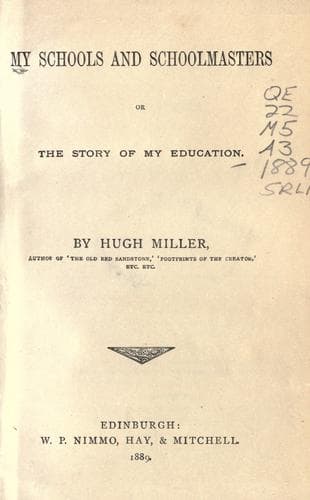
My Schools and Schoolmasters; Or, The Story of My EducationMiller, Hugh
Philosophy
My Schools and Schoolmasters; Or, The Story of My Education
Miller, Hugh
Education -- Scotland -- History -- 19th century; Geologists -- Scotland -- Biography; Miller, Hugh, 1802-1856 -- Knowledge and learning
boys themselves usually thought him quite suitable enough.
He was in the habit of advising the parents or relations of those he
deemed his clever lads, to give them a classical education; and meeting
one day with Uncle James, he urged that I should be put on Latin. I was
a great reader, he said; and he found that when I missed a word in my
English tasks, I almost always substituted a synonym in the place of it.
And so, as Uncle James had arrived, on data of his own, at a similar
conclusion, I was transferred from the English to the Latin form, and,
with four other boys, fairly entered on the "Rudiments." I laboured with
tolerable diligence for a day or two; but there was no one to tell me
what the rules meant, or whether they really meant anything; and when I
got on as far as _penna_, a pen, and saw how the changes were rung on
one poor word, that did not seem to be of more importance in the old
language than in the modern one, I began miserably to flag, and to long
for my English reading, with its nice amusing stories, and its
picture-like descriptions. The Rudiments was by far the dullest book I
had ever seen. It embodied no thought that I could perceive,--it
certainly contained no narrative,--it was a perfect contrast to not only
the "Life and Adventures of Sir William Wallace," but to even the
Voyages of Cook and Anson. None of my class-fellows were by any means
bright;--they had been all set on Latin without advice of the master;
and yet, when he learned, which he soon did, to distinguish and call us
up to our tasks by the name of the "heavy class," I was, in most
instances, to be found at its nether end. Shortly after, however, when
we got a little farther on, it was seen that I had a decided turn for
translation. The master, good simple man that he was, always read to us
in English, as the school met, the piece of Latin given us as our task
for the day; and as my memory was strong enough to carry away the whole
translation in its order, I used to give him back in the evening, word
for word, his own rendering, which satisfied him on most occasions
tolerably well. There were none of us much looked after; and I soon
learned to bring books of amusement to the school with me, which, amid
the Babel confusion of the place, I contrived to read undetected. Some
of them, save in the language in which they were written, were identical
with the books proper to the place. I remember perusing by stealth in
this way, Dryden's "Virgil," and the "Ovid" of Dryden and his friends;
while Ovid's own "Ovid," and Virgil's own "Virgil," lay beside me,
sealed up in the fine old tongue, which I was thus throwing away my only
chance of acquiring.
Public-domain text, read in full here on John Shaqi.
Reviews
Reviews
No reviews yet
Be the first to share your thoughts on this work.
Join the Discussion
Join the discussion
Sign in to leave a comment or review.
Sign InorCreate an account