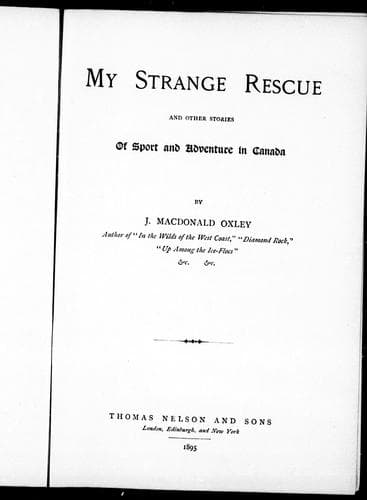
My Strange Rescue, and Other Stories of Sport and Adventure in CanadaOxley, J. Macdonald (James Macdonald)
General
My Strange Rescue, and Other Stories of Sport and Adventure in Canada
Oxley, J. Macdonald (James Macdonald)
Canada -- Juvenile fiction; Canada -- Juvenile literature
They are wildly fond of any article of civilized clothing, and the
head-man at one settlement exhibited no little pride in the possession
of a stand-up linen collar, almost worthy to be placed beside one of Mr.
Gladstone’s. Although he displayed it to the utmost advantage, he did
not, like the Fiji chieftain, consider all other clothing superfluous.
When stores were being landed at the stations, the Eskimos would gather
about and offer their services, which were always accepted, and then all
day long they would toil cheerfully side by side with their white
brethren, requiring no other remuneration than biscuits. When so much
has been written by Arctic explorers about the incorrigible kleptomania
of the natives, it is no less a matter for surprise than for
gratification that Lieutenant Gordon can bear this testimony as to the
moral status of the Eskimos at Hudson Bay: "One word may be said in
regard to their honesty. Although scraps of iron and wood possess a
value to them which we can hardly appreciate, they would take nothing
without first asking leave. Not even a chip or broken nail was taken
without their first coming to ask permission of the officer who was on
duty!"
No doubt the fact that practical prohibition prevails has something to
do with this highly commendable showing. The law, aided and abetted by
the vigilant missionaries, shuts out everything stronger than
lime-juice, and the path of the Eskimo is free from the most seductive
and destructive of all temptations, except when some unprincipled whaler
offers him a pull out of his flask. This, however, is a rare
occurrence, and there is no record of any such disturbance ever having
been raised as would in more highly civilized communities call for the
interference of the police. Although the simplicity of their life and
their freedom from many modern vices conduce to longevity, these
advantages are more than counterbalanced by the strain put upon their
constitutions by the severity of the climate and the incessant struggle
for food. Consequently they soon age, and seldom live beyond sixty
years.
The doctrine that cleanliness is next to godliness finds few adherents
in Eskimo land. The rule seems to be to eschew washing throughout the
year, and many a mighty hunter goes through life innocent of a bath,
unless, indeed, he should happen to be tumbled out of his kayak by some
irate walrus with other than sanitary designs in mind. Mr. Tuttle, the
historian of the first Hudson Bay expedition, is authority for the
statement that the children, when very young, are sometimes cleaned by
being licked with their mother’s tongue before being put into the bag of
feathers that serves them as bed, cradle, and blanket; but one cannot
help thinking that this particular version of "a lick and a promise" is
rather too laborious to have extensive vogue.
Public-domain text, read in full here on John Shaqi.
Reviews
Reviews
No reviews yet
Be the first to share your thoughts on this work.
Elsewhere in the archive
Join the Discussion
Join the discussion
Sign in to leave a comment or review.
Sign InorCreate an account