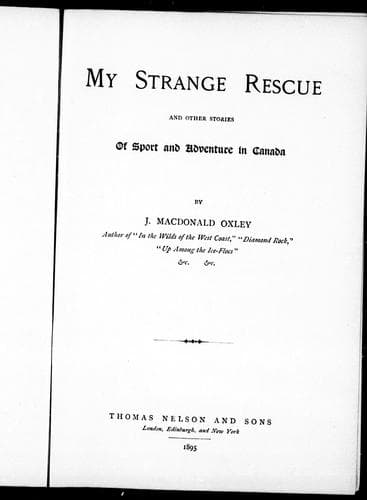
My Strange Rescue, and Other Stories of Sport and Adventure in CanadaOxley, J. Macdonald (James Macdonald)
General
My Strange Rescue, and Other Stories of Sport and Adventure in Canada
Oxley, J. Macdonald (James Macdonald)
Canada -- Juvenile fiction; Canada -- Juvenile literature
So familiar has the world been made through the medium of Arctic
exploration literature with the igloos (huts), kayaks and umiaks
(boats), sledges, dogs, harpoons, and other possessions of these people,
which are precisely the same wherever they may be found, that reference
to them seems unnecessary, especially as the Canadian Eskimos offer
nothing peculiar. But, before concluding, a few words must be added as
to the intellectual and moral characteristics of the race. Their
intelligence is considerable. In some instances they display not only a
taste but a talent for music, chart-making, and drawing. One case is
mentioned where a mere lad drew an excellent outline of the coast for
over a hundred miles, indicating its many irregularities with
astonishing accuracy. They are capital mimics, and are apt at learning
the songs and dances of their white visitors. But they are poor men of
business. They generally leave to the purchaser the fixing of the price
of anything they have to sell.
It is said that in their private lives their state of morality is low,
although they avoid indecency calculated to give public offence.
Stealing and lying were unknown among them until these "black arts" were
introduced by the whites as products of civilization, and, unhappily,
the natives are proving apt pupils. They are also somewhat given to
gambling. Although by no means without courage, they seldom quarrel,
and never go to war with one another.
As to religion, the Eskimos, before they accepted Christianity, had
little or none that was worthy of the name. They believe in the
immortality of the soul, but liberally extend this doctrine to the lower
animals also, which they endow with souls. They hold, also, that human
souls can pass into the bodies of these very animals.
With respect to the higher powers, their creed is that the world is
ruled by supernatural beings whom they call "owners;" and as almost
every object has its owner, this would seem to be a kind of Pantheism.
After death human souls go either up or down; but in curious contrast to
the belief of all other races, the good, in their opinion, go to the
nether world, where they bask in a land, not of milk and honey, but of
inexhaustible seal meat and blubber. The bad, on the other hand, go to
the upper world, where they suffer what a fashionable preacher
euphemized as "eternal uneasiness," not from excess of heat but from
frost and famine. There they are permitted to lighten their misery by
playing ball with a walrus head, which diversion, by the way, in some
inexplicable fashion, gives rise to the aurora borealis.
Like all aborigines they have their own legend of the deluge, and to
this day they proudly point out a large island lying between Okkak and
Hebron, rising to the height of nearly seven thousand feet, which they
claim was the only spot left uncovered by the flood, and upon which a
select party of their antediluvian ancestors survived the otherwise
all-embracing catastrophe.
Public-domain text, read in full here on John Shaqi.
Reviews
Reviews
No reviews yet
Be the first to share your thoughts on this work.
Elsewhere in the archive
Join the Discussion
Join the discussion
Sign in to leave a comment or review.
Sign InorCreate an account