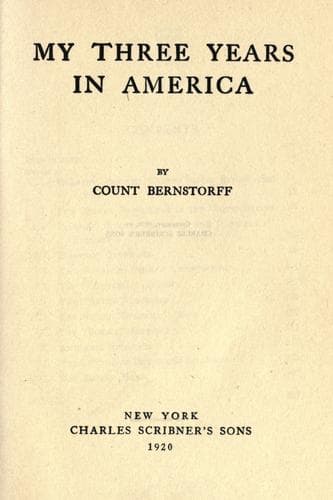
My Three Years in AmericaBernstorff, Johann Heinrich, Graf von
History
My Three Years in America
Bernstorff, Johann Heinrich, Graf von
Germany -- Foreign relations -- United States; United States -- Foreign relations -- Germany; World War, 1914-1918
In many of his remarks at that time, Colonel House
proved to be right, since the war was decided mainly by the entry
of America and the consequent overwhelming superiority in men,
money and material.
Meanwhile, as a result of the traffic in munitions, feeling in
Germany had turned sharply against the United States. Our position
with regard to this question was very unfavorable as we had no legal
basis for complaint. The clause of the Hague Convention which permitted
such traffic had been included in the second Hague Convention at our
own suggestion. Nevertheless it was natural that the one-sided support
of our enemies by the rapidly growing American war industry roused
strong feeling in Germany. As a result there began a controversy
with the American Government similar to that with England during the
war of 1870-71. Even in the United States there was a considerable
minority which disapproved of the munitions traffic, though on moral
rather than political or international grounds. It goes without
saying that the agitation of this minority was supported in every
way by the German representatives. There was no law in America
to prohibit such support, which could not, moreover, be regarded
as a breach of American neutrality. It is true that in this way a
few Germans got themselves into an awkward position because they
were suspected of stirring up the German-Americans, who together
with the Irish played a leading part in the agitation against the
Government. In particular, Dr. Dernburg became unpopular in America,
since he began to address meetings in addition to his journalistic
work. The Washington Government regarded him as the leader of the
"hyphenated Americans" who were opposing the policy of the President's
Administration, because the latter took up the strict legal standpoint
that the traffic in munitions was permissible, and that it would
therefore be a breach of neutrality in our favor if such traffic
were forbidden after the outbreak of hostilities. President Wilson
himself even had an idea of nationalizing the munition factories,
which would have rendered traffic with the combatant Powers a breach
of international law. When, however, he sounded Congress on this
matter, it became evident that a majority could not be obtained
for such a step. The United States had already brought forward
a similar proposal at the Hague Conference with the intention of
conceding one of the chief demands of the pacifists. It was in
wide circles in America an axiom that the munitions factories were
the chief incentives to war. As during the first winter of the
war there were very few such factories in America the President's
plan was not merely Utopian but meant in all seriousness, in which
connection it should be noted that American industrial circles were
among Mr. Wilson's bitterest opponents. If Mr. Wilson's proposal
had been known to German public opinion he would have been more
favorably judged.
Public-domain text, read in full here on John Shaqi.
Reviews
Reviews
No reviews yet
Be the first to share your thoughts on this work.
Join the Discussion
Join the discussion
Sign in to leave a comment or review.
Sign InorCreate an account