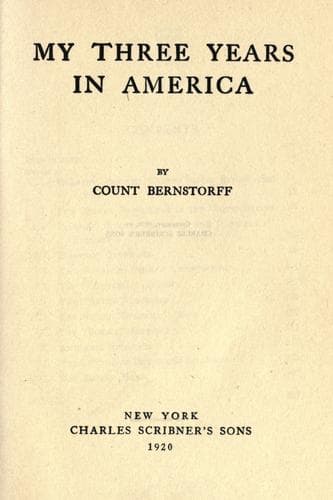
My Three Years in AmericaBernstorff, Johann Heinrich, Graf von
History
My Three Years in America
Bernstorff, Johann Heinrich, Graf von
Germany -- Foreign relations -- United States; United States -- Foreign relations -- Germany; World War, 1914-1918
There was no question of entrusting the shipping to American exporters
who had had long experience of German trade. Herr Albert from the
first considered it advisable to interfere as little as possible
with the existing business relations between the two countries,
and he left it to the firms trading with Germany to carry through
their commissions as best they could. This method of supplying
Germany with food, however, completely failed. The fault also lies
partly with the importers in Germany. In these circles it was for a
long time hoped, but in vain, to obtain consignments from American
firms. Further, they clung too long to the business methods of peace,
demanded estimates, bargained about prices, and, most important of
all, did not realize that the risk to the exporter as a result of
the English blockade made special compensation or payment necessary.
In consequence the valuable time at the beginning of the war was
lost. Very soon, however, the American exporters withdrew completely,
because those who had had previous business relations with Germany
were known to the English, and so were suspected and finally placed
on the black list. A shipment by one of these firms would then at
once have been marked down as destined for Germany, and would have
run risk of capture. Herr Albert, therefore, made use of special
agencies. At first, in addition to employing Danish firms, he founded
several new American export companies. These new organizations
were of course only available for a short time, and, as soon as
they came under English suspicion and were consequently rendered
useless, had to be replaced by others.
The reproach that has been made from time to time that these enterprises
were confined to a small clique of confidential persons and firms
seems to be unjustified by the facts. The circumstances demanded the
closest possible secrecy, for otherwise the origin and destination
of the cargoes would have been discovered by the English secret
service before they left New York. This would have involved the
complete loss of the cargo as a result of the English embargo.
That firms already engaged, even though for a short time, in
German-American commerce could not be considered is obvious. Not only
were they known to the English, but in some cases their German names
already laid them open to suspicion. Accordingly, their occasional
requests that they should carry through enterprises of this nature
were consistently refused. This criticism is only made by a small
circle of German-American firms grouped round the German Union and
the so-called German-American Chamber of Commerce, and originated
in an anxiety, understandable but based on an inadequate knowledge
of the facts, to participate in the undertakings.
Public-domain text, read in full here on John Shaqi.
Reviews
Reviews
No reviews yet
Be the first to share your thoughts on this work.
Join the Discussion
Join the discussion
Sign in to leave a comment or review.
Sign InorCreate an account