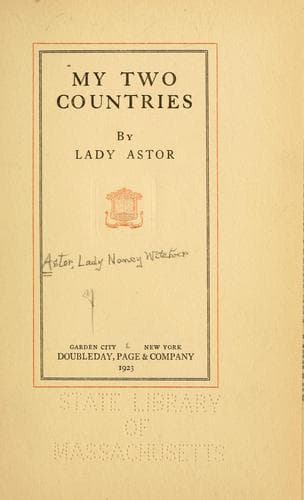
My Two CountriesAstor, Nancy Witcher Langhorne Astor, Viscountess
General
My Two Countries
Astor, Nancy Witcher Langhorne Astor, Viscountess
Reconstruction (1914-1939); Women -- Political activity
A common purpose shared by a whole nation, if that purpose is one of
sacrifice, idealism, and helpfulness, is a wonderful thing. Think what
a common purpose shared by many nations--a purpose with an ideal and
helpfulness and a sacrifice of self--would be. This is what the war
should have left--and even though, I admit, it is not obvious, I cannot
help believing that that common purpose remains--remains anyhow in the
hearts of those who suffered and in the hearts of those who care.
I cannot speak for the women of Europe, but I think I can speak for
the women of England, and I say that they, through suffering, have
determined that so far as within them lies, there is no sacrifice
too great to make for the cause of peace. I have seen the women of
England when they were determined. I have seen them tried and not found
wanting. I can tell you it was a glorious sight. You may read diaries
of the war which tell of dinner parties and plenty in London; but that
no more represents the women of England than a night dancing-club in
New York or a red-light district in some city here represents the women
of America.
I will tell you what the spirit of English women was and is: The Bishop
of Exeter, Lord Robert Cecil’s brother, had two splendid boys killed
in the first three years of the war. The last year of the war 2,000
American Submarine Chaser sailors were stationed in Plymouth, which is
in the Bishop’s diocese. His wife, Lady Florence, did everything she
could to make these American boys less lonely. She had as many as she
could for Christmas, and hardly ever was her house without some of
them. About January, 1918, just before one of the fiercest battles,
she said to her sister: “I don’t believe I could go on if Jack (her
last son) was taken.” The next morning a wire came saying Jack was
killed. This was on a Monday. On Thursday, Lady Florence had planned an
afternoon party for your sons--those gallant submarine chasers. When
she arrived at Plymouth, and I saw her white, stricken face, I begged
her not to have the boys--they would just remind her of Jack as he had
been. She looked at me with eyes I can never forget and said: “But,
Nancy, they too are far away from home, and we must do all we can.” The
party went off and the boys, never guessing her sorrow, were charmed
as usual with the Bishop and his wife’s cheerful kindness. That night
I walked around to the American Y. M. C. A., and in talking to some
of the boys told them of Lady Florence’s sorrow. One boy, with tears
in his eyes, broke out: “Oh, why did you let her do it?” Then he said:
“If ever any one speaks ill to me of England, I don’t feel that I could
keep from killing them.” That, friends, was the spirit of the women of
England. Suffering only made them kinder and braver, and that’s why I
love and admire England.
Public-domain text, read in full here on John Shaqi.
Reviews
Reviews
No reviews yet
Be the first to share your thoughts on this work.
Join the Discussion
Join the discussion
Sign in to leave a comment or review.
Sign InorCreate an account