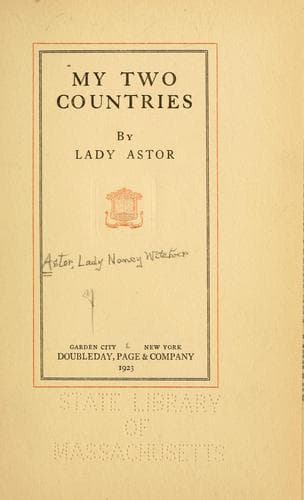
My Two CountriesAstor, Nancy Witcher Langhorne Astor, Viscountess
General
My Two Countries
Astor, Nancy Witcher Langhorne Astor, Viscountess
Reconstruction (1914-1939); Women -- Political activity
I spoke of the League of Nations, and how it could never be a real
League without America, and that America’s greatness would never be
true unless she helped the whole world; in fact, I just spoke out. I
would have understood had they said: “This woman talks too freely; we
don’t want to hear any more of what she has got to say.” I would have
understood that; but they didn’t do that. After my first two speeches
we got wires from all over America, from all kinds of associations
and people asking us to speak--business men, Chambers of Commerce,
colleges, etc.--that’s the wonderful part of the whole thing. I dared
speak of England and the League of Nations, and of the pity that
America should not be in, and they still wanted to hear. I have always
felt that not only are America’s laws Anglo-Saxon, but her ideals are
Anglo-Saxon, and I have always felt, too, that until people from other
countries brought better laws and higher ideals than my forefathers
carried from this country, that those laws and those ideals would be
accepted, and would govern and guide all those millions of people from
other nations who came to America. For the sake of humanity, one would
wish America to accept better laws and better ideals if she could find
them. I don’t think she has found them yet. She may have improved
them, but the background and bedrock are the same. Virginia did improve
them, and I was reminded in Canada that Nova Scotia got her laws
from the Virginians, who had improved them to suit a young country,
and from these laws a great nation is springing. Let no one forget
America’s greatness. She is very young compared to the Old World. She
may seem precocious--young people generally are--but she cares about
real things, and her heart is as big as her territory. Ask any one
who goes there, and they nearly all tell the same story of generous
hospitality and a great sense of friendliness. I, being American born
of only stout Anglo-Saxon forefathers, would naturally always love
the real America, but this time I loved her more than ever, for I saw
that my thoughts about her were right, and I loved her for letting
me speak of England--how she had suffered, how she fought, and how
hopeless she was at ever speaking of herself. I told them that perhaps
some of her greatness lay in her reticence. When you do right, you can
afford to be reticent. It is only people who are doing wrong who need
to be continually talking. I knew that though ten Englishmen were being
killed in the war for every two overseas men, to read the papers one
would have thought that only the overseas men were fighting. So much
was it so, that the German-Americans tried to use it as a proof of
England’s selfishness. She saved her own men, they said, and sent the
overseas men into the worst places. You and I and the men themselves
know better. It was England’s dauntless chivalry which made her give
first place in her accounts of the battles to her gallant sons who came
so far to help her.
Public-domain text, read in full here on John Shaqi.
Reviews
Reviews
No reviews yet
Be the first to share your thoughts on this work.
Join the Discussion
Join the discussion
Sign in to leave a comment or review.
Sign InorCreate an account