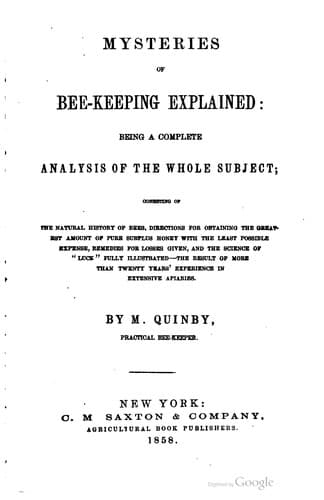
Mysteries of Bee-keeping ExplainedQuinby, M. (Moses)
Science
Mysteries of Bee-keeping Explained
Quinby, M. (Moses)
Bees
There has an idea been advanced, that candied honey is injurious to
bees, even said to be fatal. I never could discover any thing further,
than it was a perfect waste, while in this state. When boiled, and a
little water added, it appears to be just as good as any. Nearly every
stock will have more or less of it on hand at this season; but as warm
weather approaches, and the bees increase to warm the hive, it seems to
get liquified, from this cause alone. The bees, when compelled to use
honey from these cells, thus candied, waste a large portion; a part is
liquid, and the rest is grained like sugar, which may be seen on the
bottom-board, as the bees work it out very often. Another object in
feeding bees, is to give inferior honey, mixed with sugar and flavored
to suit the taste, to the bees, and let them store it in boxes for
market. Now, I have no faith in honey undergoing any chemical change in
the stomach of the bee,[14] and cannot recommend this as the honest
course. Neither do I think it would be very profitable, feeding to this
extent, under any circumstances. I have a few times had some boxes
nearly finished and fit for market at the end of the honey season; a
little more added would make them answer. I have then fed a few pounds
of good honey, but always found that several pounds had to be given the
bees to get one in the boxes.
[14] Mr. Gillman's patent for feeding bees, is based on the
principle of a chemical change. It is said that the food he gives
to the bees, when poured into the cells, becomes honey of the
first quality. This appears extremely mysterious; for it is well
understood that when a bee has filled its sack it will go to the
hive, deposit its load, and return immediately for more; and will
continue its labor throughout the day, or until the supply fails;
each load occupying but few minutes. The time in going from the
feeder to the hive is so short that a change so important is not
at all probable. The nature of bees seems to be to _collect_
honey, not _make_ it; hence we find, when bees are gathering from
clover, they store quite a different article than when from
buckwheat,--or when we feed West India honey, in quantities
sufficient to have it stored _pure_ in the boxes, we find that it
has lost none of its bad taste in passing through the sacks of
our northern bees.
Public-domain text, read in full here on John Shaqi.
Reviews
Reviews
No reviews yet
Be the first to share your thoughts on this work.
Elsewhere in the archive
Join the Discussion
Join the discussion
Sign in to leave a comment or review.
Sign InorCreate an account