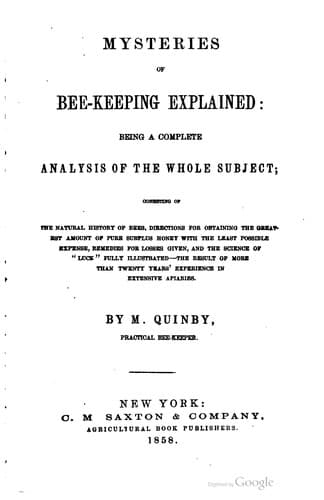
Mysteries of Bee-keeping ExplainedQuinby, M. (Moses)
Science
Mysteries of Bee-keeping Explained
Quinby, M. (Moses)
Bees
It appears most probable that, if Southern honey and cheap sugar
form the basis of his food, (which it is said to,) that it is
flavored with something to disguise the disagreeable qualities of
the compound. Should this be the secret, it would seem like a
waste to feed it to bees--a portion would be given to the brood,
and possibly the old bees might not always refrain from sipping a
little of the tempting nectar. Why not, when the compound was
ready,--instead of wasting it by this process,--put it directly
in market? Or, is it necessary to have it in the combs to help
psychologize the consumer into the belief that it is honey of a
pure quality?
CHAPTER X.
DESTRUCTION OF WORMS.
I shall not give a full history of the moth in this chapter, as spring
is not the time they are most destructive. It will be further noticed
under the head of Enemies of Bees. But as this is a duty belonging to
spring, a partial history seems necessary.
As soon as the bees commence their labors, the worms are generally
ready to begin theirs.
SOME IN THE BEST STOCKS.
You will probably find some in your best stocks; but don't be
frightened; this is not the season when they often destroy your stocks,
yet they injure them some.
HOW FOUND.
In the morning, when cool, raise the hive, and you will find them on
the board. You must not suppose that these chaps are bred outside the
hive, got their growth, and are now on their way among the bees, but
the reverse. They are _bred in the hive_, and most of them are on the
way out, and this is the precise time to arrest them and bring them to
justice for their crimes.
A TOOL FOR THEIR DESTRUCTION.
Public-domain text, read in full here on John Shaqi.
Reviews
Reviews
No reviews yet
Be the first to share your thoughts on this work.
Elsewhere in the archive
Join the Discussion
Join the discussion
Sign in to leave a comment or review.
Sign InorCreate an account