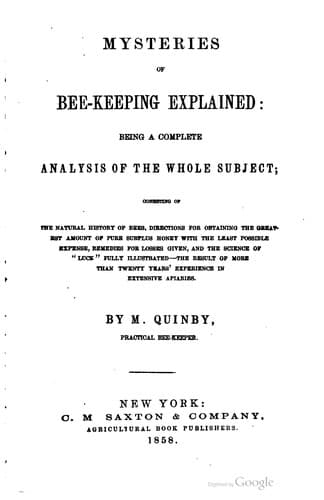
Mysteries of Bee-keeping ExplainedQuinby, M. (Moses)
Science
Mysteries of Bee-keeping Explained
Quinby, M. (Moses)
Bees
To a person that has never inverted a hive full of bees, even to
overflowing, or never has seen it done, it appears like a great
undertaking, as well as the probability of ruining the stock! But after
the first trial, the magnitude of the performance is greatly
diminished, and will grow less with every repetition of the feat, until
there is not the least dread attending it. Without tobacco smoke I
hardly think it practicable, but with it, there is not the least
difficulty. It would be very unsatisfactory to turn over a hive and
nothing to drive the bees away from the very places on the combs that
you wish particularly to inspect. The smoke is just the thing to do it!
As for the bad effects of such overturning and smoking, I never
discovered any.
REQUISITES BEFORE PREPARATION OF QUEEN'S CELLS.
I have found the process for all regular swarms something like this:
before they commence, two or three things are requisite. The combs must
be crowded with bees; they must contain a numerous brood advancing from
the egg to maturity; the bees must be obtaining honey either by being
fed or from flowers. Being crowded with bees in a scarce time of honey
is insufficient to bring out the swarm, neither is an abundance
sufficient, without the bees and the brood. The period that all these
requisites happen together, and remain long enough, will vary with
different stocks, and many times do not happen at all through the
season, with some.
These causes then appear to produce a few queen-cells, generally begun
before the hive is filled, (sometimes when only half full, but usually
remain as rudiments till the next year, when the foregoing conditions
of the stock may require their use).
STATE OF QUEEN'S CELL WHEN USED.
They are about half finished, when they receive the eggs; as these eggs
hatch into larvæ, others are begun, and receive eggs at different
periods for several days later. The number of such cells seem to be
governed by the prosperity of the bees: when the family is numerous,
and the yield of honey abundant, they may amount to twenty, at other
times perhaps not more than two or three; although several such cells
may remain empty. I have already said that a failure, (or even a
partial one), in the yield of honey at any time from the depositing of
royal eggs till the sealing of the cells, (which is about ten days),
would be likely to bring about their destruction. Even after being
sealed, I have found a few instances where they were destroyed.
STATE WHEN SWARMS ISSUE.
But when there is nothing precarious about the honey, the sealing of
these cells is the time to expect the first swarm, which will generally
issue the first fair day after one or more are finished. I never missed
a prediction for a swarm 48 hours, when I have judged from these signs,
in a prosperous season. When there is a partial failure of honey, the
swarm sometimes will wait several days after finishing them.
CLUSTERING OUTSIDE NOT ALWAYS TO BE DEPENDED UPON.
Public-domain text, read in full here on John Shaqi.
Reviews
Reviews
No reviews yet
Be the first to share your thoughts on this work.
Elsewhere in the archive
Join the Discussion
Join the discussion
Sign in to leave a comment or review.
Sign InorCreate an account