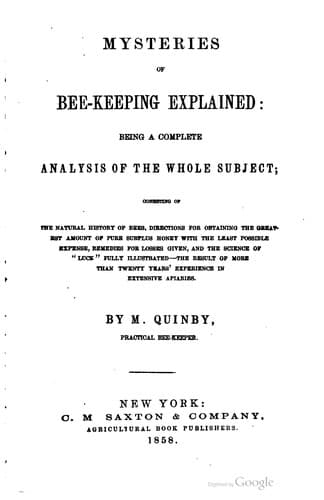
Mysteries of Bee-keeping ExplainedQuinby, M. (Moses)
Science
Mysteries of Bee-keeping Explained
Quinby, M. (Moses)
Bees
The clustering out of the bees I find but a poor criterion to judge
from, further than full hives do swarm--many such do not.
EXAMINATIONS--THE RESULT.
I will detail a few circumstances, that have led to these conclusions.
Some years ago the honey began to fail, when only about one third of my
good stocks had cast swarms; and all at once, the issues began to "be
few and far between." I had previously examined, and found they had
gone into preparations pretty extensively; by having not only
constructed cells, but occupied them with royal eggs and larvæ. Now I
examined again, and found five out of six had destroyed them, (at the
same time the bees clustered out extensively). This put an end to all
hopes of swarms here. Some few had finished their cells, and these, I
had some hopes, would send out the swarms; but the dry weather caused
some misgivings. After waiting three or four days and none coming, I
found these sealed cells destroyed also, and had no more swarms that
season. Subsequent observations have fully confirmed these things. One
season some of the hives commenced preparations at two different
periods, and then abandoned them without swarming at all, through the
summer. The first time it was the last of May, the next in July.
REMARKS.
The failure of honey was the cause, without any doubt. And who shall
say, these bees were not wise in their conduct? What prudent man would
emigrate with a family, if the prospect of a famine was plainly
indicated, when, by remaining at home, there was enough, at least for
the present? Who can help but admire this wise and beautiful
arrangement? The combs must contain brood; the bees must find honey
during the rearing of the queens. If a swarm were to issue the moment
of obtaining honey, the consequence might be fatal, as there would not
be a numerous brood to hatch out, and replenish the old stock with bees
sufficient to keep out the worms. Were they to issue at any time, as
soon as the bees had increased enough in numbers to spare a swarm,
without regard to the yield of honey, they might starve.
CONFLICTING THEORIES.
I find many theories conflicting with these views, which appear to call
for some remarks. It is generally supposed that a young queen must be
matured to issue with the swarms, and the old one with the old bees are
permanent residents of the old hive.
BOTH OLD AND YOUNG LEAVE WITH SWARMS.
It is probable that no rule governs the issue of workers. Old and young
come out promiscuously. That old bees come out may be known sometimes,
by so many leaving, that not a quarter as many will be left, as
commenced work in the spring. That young bees leave, any one may be
satisfied on seeing a swarm issue; a great many too young and weak to
fly will drop down in front of the hive, having come out now for the
first time, and perhaps some of them had not been out of the cell an
hour; these very young bees are known by the color.
CAUSE OF THE QUEEN'S INABILITY TO FLY SUGGESTED.
Public-domain text, read in full here on John Shaqi.
Reviews
Reviews
No reviews yet
Be the first to share your thoughts on this work.
Elsewhere in the archive
Join the Discussion
Join the discussion
Sign in to leave a comment or review.
Sign InorCreate an account