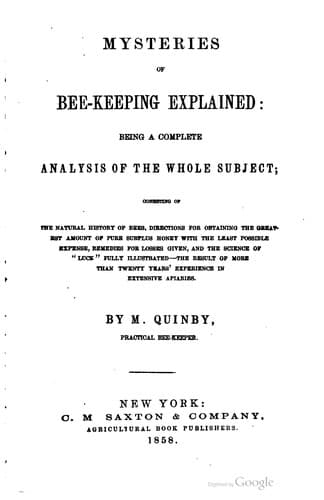
Mysteries of Bee-keeping ExplainedQuinby, M. (Moses)
Science
Mysteries of Bee-keeping Explained
Quinby, M. (Moses)
Bees
The old queen often gets down in the same way; but I would assign
another cause for her inability to fly; that is, I would suggest it to
be her burden of eggs.
EVIDENCE OF THE OLD QUEEN'S LEAVING.
That the old queen does leave with the first swarm is indicated by
several things: one is, eggs may often be found on the board the next
morning; another, when the first swarm has left, and before any of
these royal cells hatch, the bees may be driven out and no queen will
be found, or you may drive out the bees at the end of three weeks, and
the brood of workers will be about all hatched, the drone brood not
quite as near. The combs may also contain some eggs, and perhaps some
very young larvæ, that have been deposited by the young queen, which
begins to lay usually sixteen or eighteen days after the first swarm.
This shows a cessation of laying eggs for about two weeks. First swarms
will have eggs in the cells as soon as they are made to hold them,
which is often within 24 hours after being hived; occasionally a new
piece of comb will fall down, and, if the cells are deep enough, they
are almost certain to contain eggs. I could add other proof, but the
attentive observer will discover it himself.
MR. WEEKS' THEORY NOT SATISFACTORY.
Mr. J. M. Weeks, in his work on bees, says, "Two causes and two only
can be assigned why bees ever swarm: the first, the crowded state of
the hive; the second, to avoid the battle of the queens." The first
cause producing first swarms, the other second, third, &c. Mr. Colton's
patent hive, it is said, can be made to swarm "at any time within two
days," merely for want of room. By removing the six boxes attached to
it, the bees are compelled to crowd into the main body of the hive, and
swarm out in consequence. Now, if merely crowding the hive with bees is
the only cause of first swarms, how is it that half or more of mine
refused to swarm, when a great many, for want of room, were crowded
outside for weeks, and great numbers maturing every day to crowd them
still more? To me the reason is plain, that some of the
before-mentioned requisites were wanting. Mr. Weeks further says, when
the first swarm has left, "not a single queen, in any stage of
minority, is left in the old hive; the bees, destitute of a queen, set
about constructing several royal cells, take larvæ or eggs and put in
them, and feed with royal jelly, and in a few days have a queen."
Although I had not had much experience at the time of getting his work,
I had some doubts, because I found that all hives that became full and
began to run over, did not swarm, and some others swarmed before being
quite full; it seemed as if something like a preparation beforehand was
requisite. I knew of no means, for a long time, that would decide
_positively_; when it occurred to me, if I examined the old stock
immediately after the first swarm had left, I should find some
preparations if there were any; a thing so simple and easy that I felt
Public-domain text, read in full here on John Shaqi.
Reviews
Reviews
No reviews yet
Be the first to share your thoughts on this work.
Elsewhere in the archive
Join the Discussion
Join the discussion
Sign in to leave a comment or review.
Sign InorCreate an account