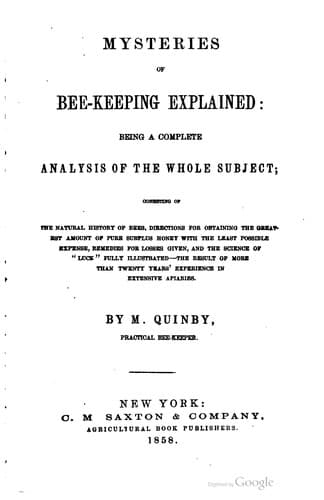
Mysteries of Bee-keeping ExplainedQuinby, M. (Moses)
Science
Mysteries of Bee-keeping Explained
Quinby, M. (Moses)
Bees
wintered well, having nearly filled the hive. Yet, in some seasons, the
first swarms, of the last of June, have failed to get enough. In
sections where much buckwheat is raised, late swarms do more towards
filling their hives than where there is none.
MORE CARE NEEDED BY AFTER SWARMS WHEN HIVED.
Should it be thought best to hive after swarms, and risk the chances,
they should receive a little extra attention after the first week or
two, to destroy the worms; a little timely care may prevent
considerable injury. They are apt to construct more combs in proportion
to the number of bees, than others; consequently, such combs cannot be
properly covered and protected. The moth has an opportunity to deposit
her eggs on them, and, sometimes, entirely destroy them.
TWO MAY BE UNITED.
Whenever these swarms issue near enough together, it is best to unite
them. I have said second swarms were generally half as large as the
first. By this rule, two second swarms would contain as many bees as a
first one, and four of the third, or one of the second issue, and two
of the third, &c. If the first and second are of the ordinary size, I
think it advisable always to return the third. But in large apiaries it
is common for them to issue without any previous warning, just when a
first one is leaving, and crowd themselves into their company, and
seeming to be as much at home as though they were equally respectable.
Whenever the hives containing our swarms are full or very near it, the
boxes should be put on without delay, unless the season of honey is so
nearly gone as to make it unnecessary.
I have found it an advantage to hive a few of these very small swarms,
on purpose to preserve queens, to supply some old stocks that sometimes
lose their own at the extreme end of the swarming season. The cases to
be mentioned at the last of the next chapter. I try and save one for
about every twenty stocks that have swarmed.
CHAPTER XIV.
LOSS OF QUEENS.
OF SWARMS THAT LOSE THEIR QUEEN.
Swarms that lose their queen the first few hours after being hived,
generally return to the parent stock; with the exception that they
sometimes unite with some other. If much time has elapsed before the
loss, they remain, unless standing on the same bench with another. On a
separate stand they continue their labor, but a large swarm diminishes
rapidly, and seldom fills an ordinary-sized hive. One singular
circumstance attends a swarm that is constructing combs without a
queen. I have never seen it noticed by any one, and may not always be
the case, but _every_ instance that has come under my notice, I have so
found it. That is, four-fifths of the combs are drone-cells; why they
thus construct them is another subject for speculation, from which I
will endeavor in this instance to refrain.
A SUGGESTION AND AN ANSWER.
Public-domain text, read in full here on John Shaqi.
Reviews
Reviews
No reviews yet
Be the first to share your thoughts on this work.
Elsewhere in the archive
Join the Discussion
Join the discussion
Sign in to leave a comment or review.
Sign InorCreate an account