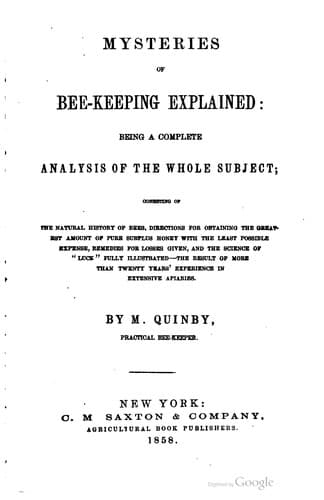
Mysteries of Bee-keeping ExplainedQuinby, M. (Moses)
Science
Mysteries of Bee-keeping Explained
Quinby, M. (Moses)
Bees
It has been suggested as a profitable speculation, "to hive a large
swarm without a queen, and give them a piece of brood-comb containing
eggs, to rear one, and then as soon as it is matured, deprive them of
it, giving them another piece of comb, and continue it throughout the
summer, putting on boxes for surplus honey. The bees having no young
brood to consume any honey, no time will be lost, or taken to nurse
them, and as a consequence they will be enabled to store large
quantities of surplus honey."
This appears very plausible, and to a person without experience
somewhat conclusive. If success depended on some animal whose lease of
life was a little longer, it would answer better to calculate in this
way. But as a bee seldom sees the anniversary of its birthday, and most
of them perish the first few months of their existence, it is bad
economy. It will be found that the largest amount of our surplus honey
is obtained from our prolific stocks. Therefore it is all-important
that every swarm and stock has a queen to repair this constant loss.
A DISPUTED QUESTION.
We now approach another disputed point in natural history, relative to
the queen leaving at any time except when leading out a swarm. Most
writers say that the young queen leaves the hive, and meets her
paramour, the drone, on the wing. Others deny this _positively_, having
watched a whole summer without seeing her highness leave. Consequently
they have arrived at the very plausible and apparently consistent
conclusion, that nature never intended it to be so, since it must
happen at a time when the existence of the whole family depends
entirely on the life of the queen. The stock at such times contains no
eggs or larvæ, from which to rear another, if she should be lost. "The
chances at such times of being devoured by birds, blown away by the
winds, and other casualties, are too many, and it is not probable the
Creator would have so arranged it." But facts are stubborn things; they
will not yield one jot to favor the most "finely-spun hypothesis;" they
are most provokingly obstinate, many times. When man, without the
necessary observation, takes a survey through animated nature, and
finds with scarcely an exception that male and female are about equal
in number, he is ready, and often does conclude that one bee among
thousands cannot be the only one capable of reproduction or depositing
eggs. Why, the idea is preposterous! And yet only a little observation
will upset this very consistent and analogous reasoning. So it appears
to be with the excursions of the young queens. I was compelled, though
reluctantly, to admit that they leave the hive. That their purpose is
to meet the drones, I cannot at present contradict. Also, that, when
the queen is once impregnated, it is operative for life, (yet it is
another anomaly), as I never detected her coming out again for that
purpose. What then is the use of the ten thousand drones that never
Public-domain text, read in full here on John Shaqi.
Reviews
Reviews
No reviews yet
Be the first to share your thoughts on this work.
Elsewhere in the archive
Join the Discussion
Join the discussion
Sign in to leave a comment or review.
Sign InorCreate an account