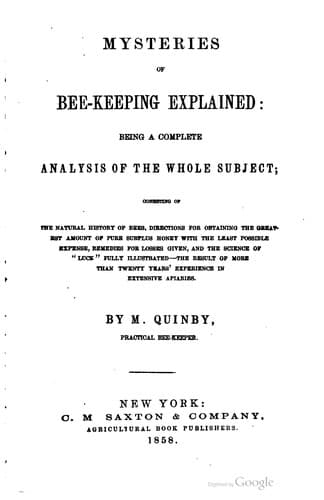
Mysteries of Bee-keeping ExplainedQuinby, M. (Moses)
Science
Mysteries of Bee-keeping Explained
Quinby, M. (Moses)
Bees
Subsequent to these experiments, I thought perhaps the jarring of the
hives in driving might have some effect on the bees, and prevent their
rearing a queen. This idea suggested the dividing hive, when the
division could be made quietly; but success was yet uncertain. I was
told to confine the bees in the old stock twenty-four hours or more,
after driving out a swarm; this I tried, with no better results. Again,
I drove out the swarm, looked out the queen, and returned her to the
old stock, compelling the new swarm to raise one. To be certain they
did so, I constructed a small box about four inches square, by two in
thickness; the sides glass. In this I put the piece of brood-comb
containing eggs and larvæ, and then put it on the hive containing the
swarm, having holes for communication, a cover to keep it dark, &c.
They were very sure to rear queens, but from some cause were lost after
they were matured.
Now, if others have been more successful in these experiments than
myself, it indicates that some favorable circumstances attended them
that did not me. I have not the least doubt but the result will be
favorable sometimes. Yet from the foregoing, I became satisfied that
not one of these methods could be relied upon. Instead of constructing
a queen's cell, and then removing the egg or larva to it from another
cell, I always found that the cell containing such egg or larva was
changed from the horizontal to the perpendicular; such cells as were in
the way below were cut off, probably using the material in forming one
for royalty, which, when finished, contains as much material as fifty
or a hundred others.
My experiments did not end here. I can now make artificial swarms, and
succeed nine times in ten with the first effort, and the reader can as
easily do the same. It must be in the swarming season, or as soon as
the first regular swarm issues. You want some finished royal cells that
any stock having cast a swarm will furnish, (unless in rare instances,
where they are too far up among the combs to be seen.)
A SUCCESSFUL METHOD.
When you are all ready, take a stock that can spare a swarm; if bees
are on the outside, raise the hive on wedges, and drive them in with a
little water, and disturb them gently with a stick. Now smoke and
invert it, setting the empty hive over. If the two hives are of one
size, and have been made by a workman, there will be no chance for the
bees to escape, except the holes in the side; these you will stop; (no
matter about a sheet tied around it.) With a light hammer or stick,
strike the hive a few times lightly, and then let it remain five
minutes. This is very essential, because most of the bees, if allowed
the opportunity, will fill themselves with honey after such
disturbance.
Public-domain text, read in full here on John Shaqi.
Reviews
Reviews
No reviews yet
Be the first to share your thoughts on this work.
Elsewhere in the archive
Join the Discussion
Join the discussion
Sign in to leave a comment or review.
Sign InorCreate an account