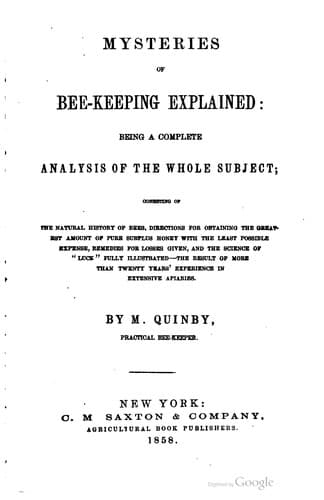
Mysteries of Bee-keeping ExplainedQuinby, M. (Moses)
Science
Mysteries of Bee-keeping Explained
Quinby, M. (Moses)
Bees
All regular swarms go forth so laden. A supply is necessary when bad
weather follows soon after. It is also used in forming wax, a very
necessary article in a new hive. The amount of honey carried out of a
stock by a good swarm, together with the weight of the bees (which is
not much), will vary from five to eight pounds.
This, allowing time for the bees to fill their sacks, and supplying the
old stock with a royal cell, I believe is entirely original: the
importance of which the reader can judge.
ADVANTAGES OF THIS METHOD.
It is very plain that a queen from such finished cell must be ready to
deposit eggs several days sooner than by any other method that we can
adopt. It is also clear that if we have a dozen queens depositing eggs
by the 10th of June, that our bees are increasing faster, on the whole,
than if but half that number are engaged in it for a month later. There
is yet another advantage. The sooner a young queen can take the place
of the old one in maternal duties, the less time will be lost in
breeding, the more bees there will be to defend the combs from the
moth, and the surest guaranty for surplus honey.
When the bees have filled their sacks, proceed to drive them into the
upper hive by striking the lower one rapidly from five to ten minutes.
A loud humming will mark their first movement. When you think half or
two-thirds are out, raise the hive and inspect progress. They are not
at all disposed to sting in this stage of proceeding, even when they
escape outside. If full of honey, they are seldom provoked to
resentment. The only care will be not to crush too many that get
between the edges of the hives. The loud buzzing is no sign of anger.
If your swarm is not large enough, continue to drive till it is. When
done, the new hive should be set on the stand of the old one. A few
minutes will decide whether you have the queen with the swarm, as they
remain quiet: otherwise uneasy, and run about, when it will be
necessary to drive again.
If both hives are one color, set the old one two feet in front; but if
of different colors, a little more. I prefer this position to setting
the old stock on one side, even when there is room; yet it can make but
little difference. Should you set it on one side, let the distance be
less. When the old stock is taken much farther than this rule, all the
bees that have marked the location (and all the old ones will have done
so) will go back to the old stand, and none but young bees that have
never left home will remain. The same will be the case with the new
swarm if moved off. It will not do to depend on the old queen keeping
them, as she does when they swarm out naturally. This has been my
experience. Try it, reader, and be satisfied, by putting either of the
hives fifteen or twenty feet distant.
Public-domain text, read in full here on John Shaqi.
Reviews
Reviews
No reviews yet
Be the first to share your thoughts on this work.
Elsewhere in the archive
Join the Discussion
Join the discussion
Sign in to leave a comment or review.
Sign InorCreate an account