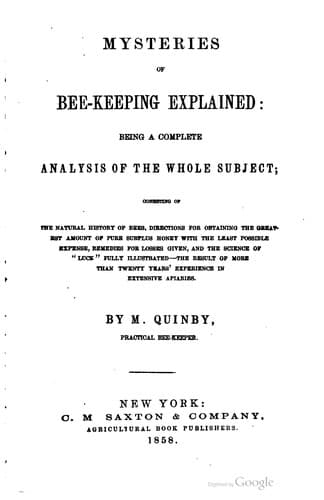
Mysteries of Bee-keeping ExplainedQuinby, M. (Moses)
Science
Mysteries of Bee-keeping Explained
Quinby, M. (Moses)
Bees
It is also recommended by some, to take only a part, say one-third or
half, in a season; thereby taking two or three years to renew the
combs. This is advisable only when the family is very small. As this
space made by pruning cannot be filled without wax and labor, our
surplus honey will be proportionate to its extent. Now suppose we take
out half the old combs, and get half a yield of box honey this year,
and the same next, or make a full operation of it and get none this
year, and a full one next. What is the difference? There is none in
point of honey, but some in trouble, and that is in favor of a full
operation at once. We have to go through with about the same trouble to
get one-third or half as to take the whole.
OBJECTION TO PRUNING.
The objection to this mode of renewing combs generally, will be the
fear of getting stung. But I can assure you there is but little danger,
not as much as to walk among the hives in a warm day. Only begin right,
use the smoke, and work carefully, without pinching them, and you will
escape unhurt generally.
STOCKS PRUNED NOW ARE BETTER FOR WINTER.
Besides the advantage of saving a large brood by pruning at this
season, such stocks will usually refill before fall, and are much
better for wintering, which is not the case when it is done later. We
must of necessity then waste the brood, and have a large space
unoccupied with combs through the winter. But few combs can then be
made, and those few must be at the expense of their winter stores,
unless we resort to feeding.
These objections apply with greater force to pruning in March or April.
The loss of brood is of much more consequence now, than in mid-summer,
or even later, and a space to be filled with combs is a serious
disadvantage. It is important that the bees should devote their whole
attention now to rearing brood, and be ready to cast their swarms as
early as possible. One _early_ swarm is worth two late ones. Suppose a
stock, instead of collecting food and nursing its young, is compelled
to expend its honey and labor in secreting wax and constructing combs
before it can proceed with breeding advantageously, it _must of
necessity_ be some weeks later.
Further, I have always found it best to have the bees out of the way,
during this operation. It will be found much more difficult to drive
the bees out of a hive in the cool weather of March or April, than in
summer, as they seem unwilling to shift their warm quarters and go into
a cold hive.
It is presumed the reader will bear in mind the disadvantages already
given of too frequently renewing combs; the little value of combs for
storing honey, _for our use_, after being once used for breeding; the
necessity of the bees using them as long as they possibly will answer;
and not compel them to be filling the hive, when they might be storing
honey of the purest quality in boxes, &c.
Vide remarks on this subject on page 22, Chapter II.
CHAPTER XVII.
DISEASED BROOD.
Public-domain text, read in full here on John Shaqi.
Reviews
Reviews
No reviews yet
Be the first to share your thoughts on this work.
Elsewhere in the archive
Join the Discussion
Join the discussion
Sign in to leave a comment or review.
Sign InorCreate an account