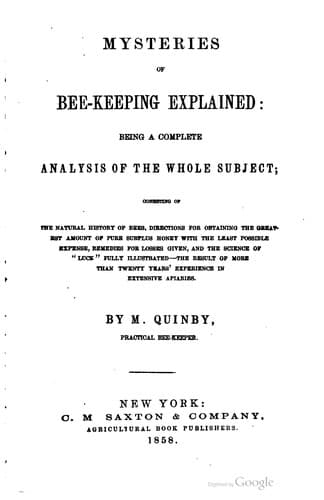
Mysteries of Bee-keeping ExplainedQuinby, M. (Moses)
Science
Mysteries of Bee-keeping Explained
Quinby, M. (Moses)
Bees
A friend of mine has had a stock in a large room eight years, that has
never swarmed, and is still prosperous! I think it very probable that
this queen will gradually decay, and possibly become barren, some weeks
before she dies; if so, this stock will soon die off. A few such cases
will probably occur in swarming hives, perhaps one in fifty, but
generally such old and feeble queens are lost when they leave with the
swarm, especially in windy weather. As long as they are able to go with
the swarm, and sometimes when they are not, I have found them
sufficiently prolific for all purposes. I would rather risk their
fecundity, and hive the swarm, than to allow the bees to return to the
parent stock, and wait eight or nine days for a young queen to mature.
A great many will remain idle, even if there is room to work in the
boxes.
CHAPTER XVI.
PRUNING.
Notwithstanding I have given the method of pruning in the chapter on
hives, (page 23, Chapter II.) it will be necessary to give the tyro in
bee-culture a few more particulars. The season for doing it is of
importance.
DIFFERENT OPINIONS AS TO TIME.
The month of March has been recommended by several; others prefer
April, August, or September. Here, as usual, I shall have to differ
from them all, preferring still another period, for which I offer my
reasons, supposing, of course, that the reader is conscious of a
freeman's privilege, that is, to adopt whatever method he thinks
proper, on this, as on any other point.
ANOTHER TIME PREFERRED.
There is but one period from February till October, when prosperous
stocks are free from young brood in the combs. If combs are taken out
when occupied, there must be a loss of all the young bees they contain;
which may be avoided. The old queen leaves with the first swarm; all
the eggs she leaves in the worker-cells will be matured in about
twenty-one days, consequently this is the time to clear out the old
combs with the least waste. A few drones will be found in the cells,
that would require a few days more to hatch, but these are of no
account. Also a few very young larvæ and some eggs may be sometimes
found, the product of the young queen; these few must be wasted, but as
the bees have expended no labor upon them as yet, it is better to
sacrifice these than the greater number left by her mother, which have
consumed their portion of food; the bees have sealed them up, and now
only require the necessary time to mature, to make a valuable addition
to the stock.
SHOULD NOT BE DELAYED.
Should this operation be put off for a time much longer than three
weeks, the young queen will so fill the combs again as to make it a
serious loss. Therefore, I wish to urge strongly attention to this
point at the proper season. If you think it unimportant to mark the
date of your first swarms for the purposes mentioned in another place,
it will be found very convenient here, for those that need pruning.
Public-domain text, read in full here on John Shaqi.
Reviews
Reviews
No reviews yet
Be the first to share your thoughts on this work.
Elsewhere in the archive
Join the Discussion
Join the discussion
Sign in to leave a comment or review.
Sign InorCreate an account