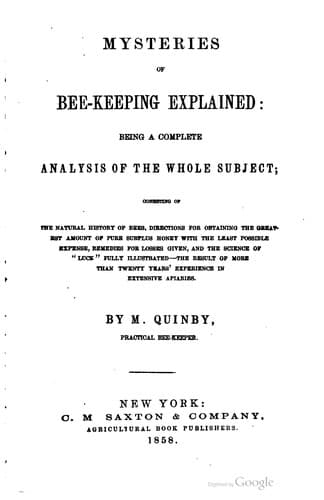
Mysteries of Bee-keeping ExplainedQuinby, M. (Moses)
Science
Mysteries of Bee-keeping Explained
Quinby, M. (Moses)
Bees
As the instinct of the flesh-fly directs her to a putrid carcass to
deposit her eggs, that her offspring may have their proper food, so the
moth seeks the hive containing combs, and where its natural food is at
hand to furnish a supply. During the day a rusty brown miller, with its
wings wrapped close around the body, may be often seen lying perfectly
motionless on the side of the hive on one corner, or the under edge of
the top, where it projects over--they are more frequent at the corners
than anywhere else, one-third of their length projecting beyond it;
appearing much like a sliver on the edge of a board that is somewhat
weather-beaten. Their color so closely resembles old wood, that I have
no doubt their enemies are often deceived, and let them escape with
their lives. As soon as daylight shuts out the view, and no danger of
their movements being discovered by their enemies, they throw off their
inactivity, and commence searching for a place to deposit their eggs,
and woe to the stock that has not bees sufficient to drive them from
the comb. Although their larvæ has a skin that the bee cannot pierce
with its sting, in most cases, it is not so with the moth, and of this
fact they seem to be aware, for whenever a bee approaches they dart
away with speed ten times greater than that of any bee, disposed to
follow! They enter the hive and dodge out in a moment, having either
encountered a bee, or fear they may do so. Now it needs no argument to
prove that when all our stocks are well protected, that it must be a
poor chance to deposit eggs, on the combs of such hives, where their
instinct has taught them is the proper place. But they _must_ leave
them somewhere. When driven from all the combs within, the next best
place is the cracks and flaws about the hive, that are lined with
propolis; and the dust and chips that fall on the floor-board of a
young swarm not full will be used. This last material is mostly wax,
and answers very well instead of comb. The eggs will here hatch and the
worms sometimes ascend to the combs; hence the necessity of keeping the
bottom brushed off clean. It will prevent those that are on the bottom
from going up; also the bees from taking up any eggs, if this should
happen to be the method. I can conceive of no other way by which they
get among the combs of a populous stock; where they are often detected,
having been deposited by some means. A worm lodged in the comb, makes
his way to the centre, and then eats a passage as he proceeds, lining
it with a shroud of silk, gradually enlarging it, as he increases in
size. (When combs are filled with honey, they work on the surface,
eating only the sealing.) In very weak families this silken passageway
is left untouched,--but removed by all the stronger ones. I have found
it asserted that "the worms would be all immediately destroyed by the
bees, were it not for a kind of dread in touching them until compelled
Public-domain text, read in full here on John Shaqi.
Reviews
Reviews
No reviews yet
Be the first to share your thoughts on this work.
Elsewhere in the archive
Join the Discussion
Join the discussion
Sign in to leave a comment or review.
Sign InorCreate an account