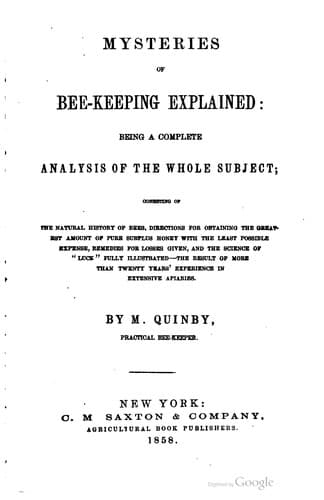
Mysteries of Bee-keeping ExplainedQuinby, M. (Moses)
Science
Mysteries of Bee-keeping Explained
Quinby, M. (Moses)
Bees
to by necessity." As the facts which led to this conclusion are not
given, and I can find none confirming it, perhaps I shall be excused if
I have no faith. On the contrary, I find to all appearance an
instinctive antipathy to all such intruders, and are removed
immediately when possessing the power.
When a worm is in a comb filled with brood, its passage being in the
centre, it is not at first discovered. The bees, to get it out, must
bite away half the thickness, removing the brood in one or two rows of
cells, sometimes for several inches. This will account for so many
immature bees found on the bottom board at morning, in the spring; as
well as in stocks and swarms but partially protected after the swarming
season.
INDICATIONS OF THEIR PRESENCE.
Sometimes a half dozen young bees, nearly mature, will be removed
alive, all webbed together, fastened by legs, wings, &c. All their
efforts for breaking loose prove unavailing. Also others that are
separate may be seen running about with their wings mutilated, or part
of their legs eaten off, or tied together! These generally are the
first symptoms of worms in our stock at this season. Although
unfavorable, it might be worse. It shows that the bees are not
discouraged yet,--that when finding the worms present, have sufficient
energy left to make an effort to rid themselves of the nuisance.
MANAGEMENT.
Should the apiarian now give them a little assistance for a few days,
they will soon be in a prosperous condition. The hive should be
frequently raised, and everything brushed out clean. If it is a new
swarm half full, that presents these indications, it should be turned
over a few times, perhaps once a week, till the worms are mastered; and
the corners below the bees examined for the cocoons, that will very
often be found there, and are easily detached and destroyed. In turning
over a hive part full, in warm weather, you should first observe the
position of the combs, and let the edges rest against the side of the
hive, otherwise they might bend over and break loose when the hive was
again set up, (by simply making a pencil mark across the top in the
direction of the combs, you may know any time after first looking).
CARE IN TURNING OVER HIVES.
When a hive is full of combs, the edges are usually attached sufficient
to steady them, and it is of less consequence which way it is turned,
yet in very warm weather the honey will run out of drone cells if
perpendicular.
In _very_ small swarms, hundreds of the young brood may be frequently
seen with their heads out of the cells, endeavoring to escape, but are
firmly held inside by these webs. I have known a few instances in such
circumstances, where it appeared as if the bees had cut off the whole
sheet of comb and let it drop, thereby ridding themselves of all
further trouble (or would be rid of it, if their owner only did his
part by taking out what fell down.)
OTHER SYMPTOMS OF WORMS.
Public-domain text, read in full here on John Shaqi.
Reviews
Reviews
No reviews yet
Be the first to share your thoughts on this work.
Elsewhere in the archive
Join the Discussion
Join the discussion
Sign in to leave a comment or review.
Sign InorCreate an account