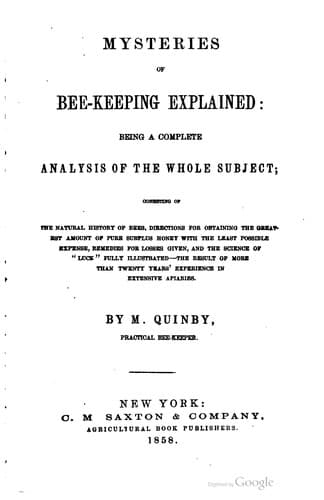
Mysteries of Bee-keeping ExplainedQuinby, M. (Moses)
Science
Mysteries of Bee-keeping Explained
Quinby, M. (Moses)
Bees
When the family is large and honey abundant, a brood of drones is
reared; the number, probably, depends on the yield of honey, and size
of the swarm, more than anything else. As honey becomes scarce, they
are destroyed. Their bodies are large and rather clumsy, covered with
short hairs or bristles. Their abdomen terminates very abruptly,
without the symmetry of the queen or worker. Their buzzing, when on the
wing, is louder, and altogether different from the others. They seem to
be of the least value of any in the hive. Perhaps not more than one in
a thousand is ever called upon to perform the duty for which they were
designed. Yet they assist, on some occasions, to keep up the animal
heat necessary in the old hive after a swarm has left.
MOST BROOD IN SPRING.
In spring and first of summer, when nearly all the combs are empty, and
food abundant, they rear brood more extensively than at any other
period, (towards fall more combs are filled with honey, giving less
room for brood.) The hive soon becomes crowded with bees, and royal
cells are constructed, in which the queen deposits her eggs. When some
of these young queens are advanced sufficiently to be sealed over, the
old one, and the greater part of her subjects, leave for a new
location, (termed swarming.) They soon collect in a cluster, and, if
put into an empty hive, commence anew their labors; constructing combs,
rearing brood, and storing honey, to be abandoned on the succeeding
year for another tenement. One in a hundred may do it the same season,
if the hive is filled and crowded again in time to warrant it. Only
large early swarms do this.
THEIR INDUSTRY.
Industry belongs to their nature. When the flowers yield honey, and the
weather is fine, they need no impulse from man to perform their part.
When their tenement is supplied with all things necessary to reach
another spring, or their store-house full, and no necessity or room for
an addition, and we supply them with more space, they assiduously toil
to fill it up. Rather than to waste time in idleness, during a
bounteous yield of honey, they have been known to deposit their surplus
in combs outside the hive, or under the stand. This natural industrious
habit lies at the foundation of all the advantages in bee-keeping;
consequently our hives must be constructed with this end in view; and
at the same time not interfere with other points of their nature; but
this subject will be discussed in the next chapter. Those peculiar
traits in their nature, mentioned in this, will be more fully discussed
in different parts of this work, as they appear to be called for, and
where proof will be offered to sustain the positions here assumed,
which as yet are nothing more than mere assertions.
CHAPTER II.
HIVES.
HIVES TO BE THOROUGHLY MADE.
Hives should be constructed of good materials, boards of good
thickness, free from flaws and cracks, well fitted and thoroughly
nailed.
Public-domain text, read in full here on John Shaqi.
Reviews
Reviews
No reviews yet
Be the first to share your thoughts on this work.
Join the Discussion
Join the discussion
Sign in to leave a comment or review.
Sign InorCreate an account