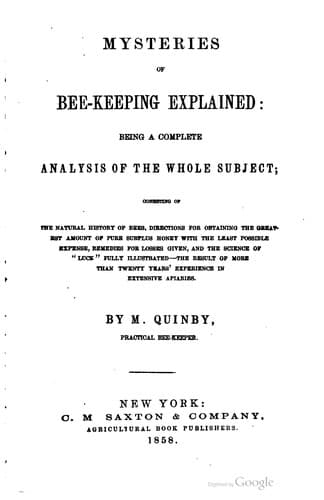
Mysteries of Bee-keeping ExplainedQuinby, M. (Moses)
Science
Mysteries of Bee-keeping Explained
Quinby, M. (Moses)
Bees
Those rustic bee-keepers who are in the habit of making their hives
very large, such as will hold from 100 to 140 lbs., and killing the
bees in the fall, and sending the honey to market, will probably
continue the use of sulphur, unless we can convince them of the greater
advantage of making the hive smaller and have fifty or eighty lbs. of
this honey in boxes which will sell for more than can be realized for
their larger hive full, and at the same time, save their bees for a
stock-hive, making a better return in the long run, than one hundred
dollars at interest. When hives are made the proper size, the honey
will not be an object sufficient to pay for destroying the bees.
SECTION OF COUNTRY MAY MAKE A DIFFERENCE IN WHAT POOR STOCKS NEED.
The kind of requisite to be supplied to our deficient stocks, will
probably depend on the section of country. Where the principal source
is clover and basswood, it will fail partially, at least, before the
end of warm weather.
Some poor or medium stocks will continue to rear brood too extensively
for their means, and exhaust their winter stores in consequence; such
will need a supply of honey. But where great quantities of buckwheat
are sown, cold weather follows almost immediately after this yield, and
stops the breeding. Consequently a scarcity of bees is more frequent
than honey. There are exceptions, of course; I am speaking of these
cases generally. My experience has mostly been in a section where this
crop is raised, and will say that there is not more than one season in
ten, but that the honey will be in proportion with the bees the first
of September; that is, if there are bees enough, there will be honey
enough.
WHEN BEES ARE NEEDED.
I have frequently had stocks with stores amply sufficient to carry a
good family through the winter, and yet too few bees to last till
January, or even to defend themselves from the robbers. Hence I am in
the habit of supplying bees oftener than honey.
I usually have some few hives with too little honey, as well as too few
bees. Now it is very plain if the bees of one or more of this class
were united with the first successfully, we should have a respectable
family. I have made additions to stocks in this way that proved
first-rate.
CAUTION.
Whenever we make additions in this manner, it would be well first to
ascertain what was the cause of a scarcity of bees; if it was
over-swarming or loss of queen, it is well enough--but if from disease,
reject them, unless the bees are to be transferred the next spring, and
then, when too many cells are occupied with dead brood, as the bees
cannot be successfully wintered.
PRINCIPAL DIFFICULTY.
The greatest difficulty in uniting two families or more in this manner,
is where they have to be taken from different places in the same
apiary; where the locations have been marked. It is sufficiently shown
that bees return to the old stand.
Public-domain text, read in full here on John Shaqi.
Reviews
Reviews
No reviews yet
Be the first to share your thoughts on this work.
Elsewhere in the archive
Join the Discussion
Join the discussion
Sign in to leave a comment or review.
Sign InorCreate an account