Mysteries of Bee-keeping ExplainedQuinby, M. (Moses)
Science
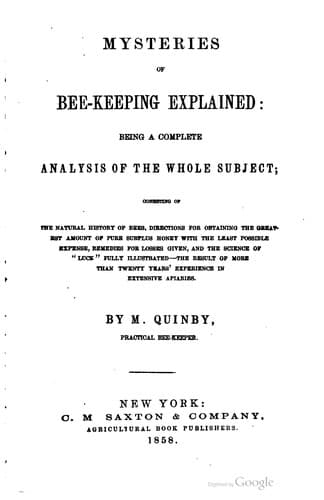
Mysteries of Bee-keeping Explained
Quinby, M. (Moses)
Bees
To prevent these results, it has been recommended "to set an empty hive
with some pieces of comb, fastened in the top in the place of the one
removed, to catch the bees that go back to the old stand, and remove
them at night for a few times, when they remain." This should be done
only when we cannot do better; it is considerable trouble; besides
this, we do not always succeed to our satisfaction.
HOW AVOIDED.
I like the plan of bringing them a mile or more for this purpose, and
have no after trouble about it. Two neighbors being that distance
apart, each having stocks in this condition might exchange bees, making
the benefit mutual. I have done so, and considered myself well paid for
the trouble. But latterly I have had several apiaries away from home,
and now manage without difficulty.
ADVANTAGES OF MAKING ONE GOOD STOCK FROM TWO POOR ONES.
This making one good stock out of two poor ones, cannot be too highly
recommended; aside from its advantages, it relieves us from all
disagreeable feelings in taking life, that we can with but little
trouble preserve.
TWO FAMILIES TOGETHER WILL NOT CONSUME AS MUCH AS IF SEPARATE.
Even when a stock already contains bees enough to make it safe for
winter, another of the same number of bees may be added, and _the
consumption of honey will not be five lbs. more than one swarm would
consume alone_. If they should be wintered in the cold, the difference
might not be one pound. Why more bees do not consume a proportionate
quantity of honey, (which the experience of others as well as myself
has thoroughly proved), is a mystery, unless the greater number of bees
creates more animal heat, and being warm, eat less, is a solution,
(which if it is, is a strong reason for keeping bees warm in winter.)
AN EXPERIMENT.
Notwithstanding all this, I cannot recommend making a _good_ stock
better by adding the bees from another good one as a source of profit.
I tried it a few times. I had purchased some large hives for market,
and wished to dispose of the bees without sulphur, and try the
experiment of uniting two or more. The next spring when they commenced
work such double stocks promised much; but when the swarming season
arrived, the single swarms, such as were good and had just about bees
enough, were in the best condition, in ordinary seasons. Whether this
was owing to the circumstance of there being already bees enough that
were beginning to crowd and interfere with each other's labors, and
less brood raised in consequence, or to some other reason, I cannot
say. I have often noticed, (as others have), that stocks which have
cast no swarms, are no better the next spring than others. The same
cause might operate in both cases. Therefore it would appear
unnecessary to unite two or more _good swarms_, unless it is to spare
our feelings in destroying the bees. The two extremes may generally be
avoided, and not have too many or too few bees.
SEASON FOR OPERATING.
Public-domain text, read in full here on John Shaqi.
Reviews
Reviews
No reviews yet
Be the first to share your thoughts on this work.
Elsewhere in the archive
Join the Discussion
Join the discussion
Sign in to leave a comment or review.
Sign InorCreate an account