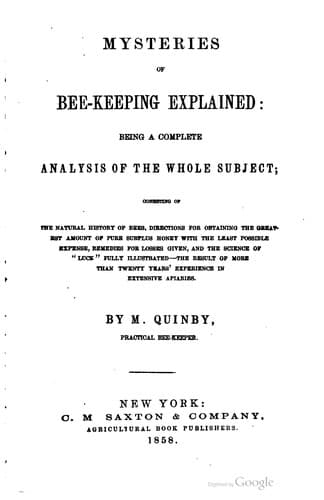
Mysteries of Bee-keeping ExplainedQuinby, M. (Moses)
Science
Mysteries of Bee-keeping Explained
Quinby, M. (Moses)
Bees
The process of uniting them is simple. Smoke both the stocks or swarms
thoroughly, and turn them over. Choose the one with the straightest
combs, or the one nearest full, to receive the contents of the other;
trim off the points of the combs to make them square across, and this
one is ready; remove the sticks from the other, and with your tools
take out the combs with the bees on as before directed, one at a time,
and carefully set them on the edges of the other; if the shape will
admit it, let the edges match; if not, let them cross. Small bits of
wood or rolls of paper will be needed between them, to preserve the
right distance. When both hives are of one size, the transferred combs
will exactly fit, if you are careful to place them as they were before.
You will now want to know, "what is to prevent these combs from falling
out when the hive is turned over?" This hive is to remain bottom up in
some dark place for some time, or till spring. (See method of wintering
bees.) The bees will immediately join these combs fast; the hive being
inverted, the honey in these combs will be consumed first; and when the
hive is again set out in spring, it will be a rare occurrence for any
pieces to drop out. Should any pieces project beyond the bottom of the
hive, they may be trimmed off even after they are fastened, any time
before setting out. An additional cross-stick may pass under the bottom
of the combs, to assist in holding them, if you desire. You will
probably never discover any difference in the subsequent prosperity in
consequence of the joining or crossing of the combs in the middle. I
have had them in this way, when they were among the most prosperous of
my stocks. As this operation is to be put off till November, it will be
an advantage in another way; that is, families of the same apiary can
be united, and will mostly forget the old location by spring, and no
difficulty arise by returning to the old stand, etc.
WHEN FEEDING SHOULD BE DONE FOR STOCK HIVES.
In some sections of country the _honey_ is more frequently wanting than
bees, or comb, and some seasons in this; in such cases, it will be
found an advantage to feed, until enough is stored for winter. This
should be done in September or October. But if they lack comb as well
as honey, and you wish to try feeding, (which I seldom do lately,) it
should be done if possible in warm weather, as they cannot work combs
to advantage in the cold. While feeding bees, it requires a great deal
of caution to prevent others from scenting the honey, and their
contentions about it. The safest place is on the top of the hive, with
a good cap over; but they will not work quite as fast, especially if
the weather is cool. The next best place is under the bottom in the
manner described in Chapter IX.
Public-domain text, read in full here on John Shaqi.
Reviews
Reviews
No reviews yet
Be the first to share your thoughts on this work.
Elsewhere in the archive
Join the Discussion
Join the discussion
Sign in to leave a comment or review.
Sign InorCreate an account