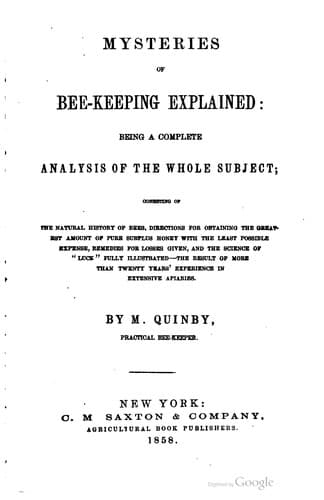
Mysteries of Bee-keeping ExplainedQuinby, M. (Moses)
Science
Mysteries of Bee-keeping Explained
Quinby, M. (Moses)
Bees
Setting out honey to feed all at once, I condemn wholly. These
disadvantages attend it: strong stocks that do not need an ounce, will
get two or three pounds, while those weaker ones, needing it more, will
not get one. Nearly every stock, in a short time, will be fighting.
Probably the first bee that comes home with a load, will inform a
number of its fellows that a treasure is close at hand. A number will
sally out immediately, without waiting for particular directions for
finding it; and mistaking other hives for the place, alight there, are
seized and probably dispatched. As soon as the honey given them is
gone, the tumult is greatly increased, and great numbers are destroyed.
If any of your neighbors near you have bees, you must expect to divide
with them.
If the honey to be fed is in the comb, and your hives are not full, and
they are to be wintered in the house, bottom up, it may be done at any
time through the winter, merely by laying pieces with honey on those in
the hive. The bees readily remove the contents into their own combs;
when empty, remove them and put in more until they have a full supply.
They will join such pieces of comb to their own; yet there will be no
harm in breaking them loose. The principal objection to feeding in this
way, will be found in the tendency to make them uneasy and disposed to
leave the hive, when we want them as quiet as possible, A thin muslin
cloth, or other means, will be necessary to confine them to the hive.
I have now given directions to avoid killing any family of bees worth
saving, if we choose.
When such as need feeding have been fed, and all weak families made
strong by additions, etc., but little more fall work is needed in the
apiary. It is only when you have weak stocks, unfit to winter, that it
is necessary to be on the lookout every warm day to prevent pillage.
CHAPTER XXII.
WINTERING BEES.
There is almost as much diversity of opinion with respect to wintering
bees as in the construction of hives, and about as difficult to
reconcile.
DIFFERENT METHODS HAVE BEEN ADOPTED.
One will tell you to keep them warm, another to keep them cold; to keep
them in the sun, out of the sun, bury them in the ground, put them in
the cellar, the chamber, wood-house, and other places, and no places at
all; that is, to let them remain as they are, without any attention.
Here are plans enough to drive the inexperienced into despair. Yet I
have no doubt but that bees have been sometimes successfully wintered
by all these contradictory methods. That some of these methods are
superior to others, needs no argument to illustrate. But what method
_is best_, is our province to inquire. Let us endeavor to examine the
subject without prejudice to bias our judgment.
THE IDEA OF BEES NOT FREEZING HAS LED TO ERRORS IN PRACTICE.
By close observation we shall probably discover that the assertion so
often repeated, that bees have never frozen except when without honey,
has led to an erroneous practice.
Public-domain text, read in full here on John Shaqi.
Reviews
Reviews
No reviews yet
Be the first to share your thoughts on this work.
Elsewhere in the archive
Join the Discussion
Join the discussion
Sign in to leave a comment or review.
Sign InorCreate an account